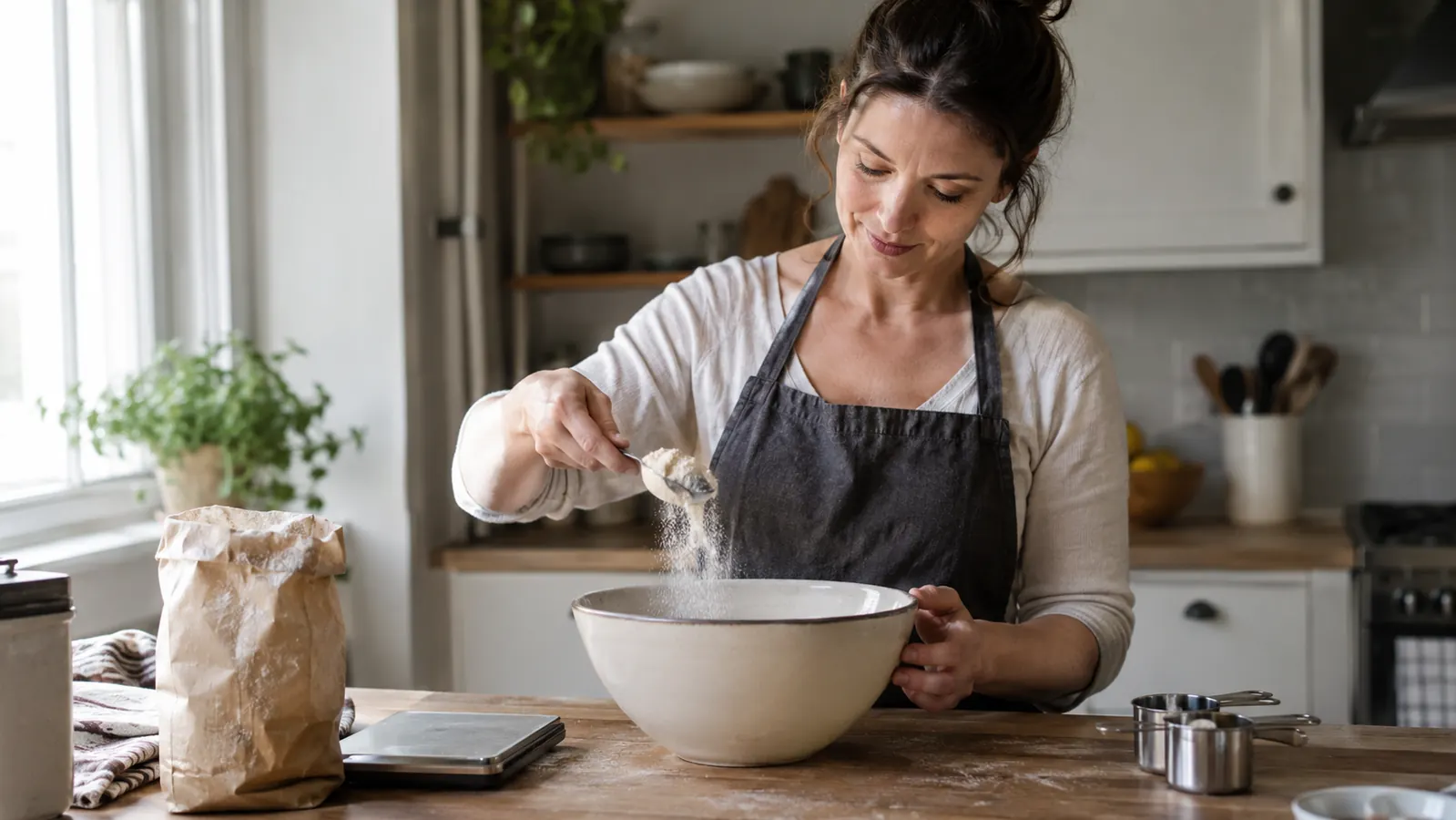
Every baker I know has a measuring cup story. Mine is the batch of chocolate chip cookies that spread into one giant cookie the week before the school bake sale, because the flour was a little packed that day. The cups did not change. The flour did. That is the whole argument for weighing your ingredients, and it is why the Escali Primo Digital Food Scale now sits on my counter next to the mixer.
The short answer to the question in the title is that for baking, the Escali Primo wins, and it wins by a wide margin. Measuring cups are still the right tool for some jobs, and I still own a set. But for flour, sugar, and anything where the result has to come out the same twice, a scale that reads to the nearest gram beats a cup every time. I did not run a lab test to reach that conclusion. I baked. Over the past year, in my ordinary kitchen outside Madison, I weighed my way through my grandmother's sugar cookie recipe, three different banana breads, a sourdough loaf, and roughly forty batches of the chocolate chip cookies my teenagers request for every school event. I kept my old measuring cups out and used them side by side, because the question was never whether a scale is nice. It was whether it earns the counter space.
Side by Side: Escali Primo vs Measuring Cups
Here is the honest version of the comparison, row by row. I tried to be fair, which means some rows go to the cups.
| Escali Primo | Measuring Cups | |
|---|---|---|
| Accuracy | Reads to the nearest 1 g, so 250 g of flour is 250 g every time | A scoop-and-level cup of flour can swing 20 to 30 g depending on how it settles |
| Multiple ingredients | Tare between ingredients and weigh everything into one bowl | Wash and dry a cup between sticky ingredients, or own three sets |
| Learning curve | Two buttons, on/off and tare. Thirty seconds to learn | No learning curve at all. Everyone has scooped since childhood |
| Liquids | Weigh milk or water in a bowl on the scale | A glass cup with a spout and a pour line is faster for a cup of milk |
| Cleanup | Sealed control panel wipes clean in seconds. Honey never touches a cup | Dishwasher safe, but molasses and honey need a soak first |
| Capacity | Weighs up to 11 lb, so a big batch of dough fits fine | Most cup sets top out around 2 cups each |
| Power | Auto shut off means it does not stay on all day | No batteries, no charging, works in a power outage |
| Best for | Bakers who want next Saturday's cookies to match this Saturday's | Quick cooking where a close guess is fine |
Where Escali Wins
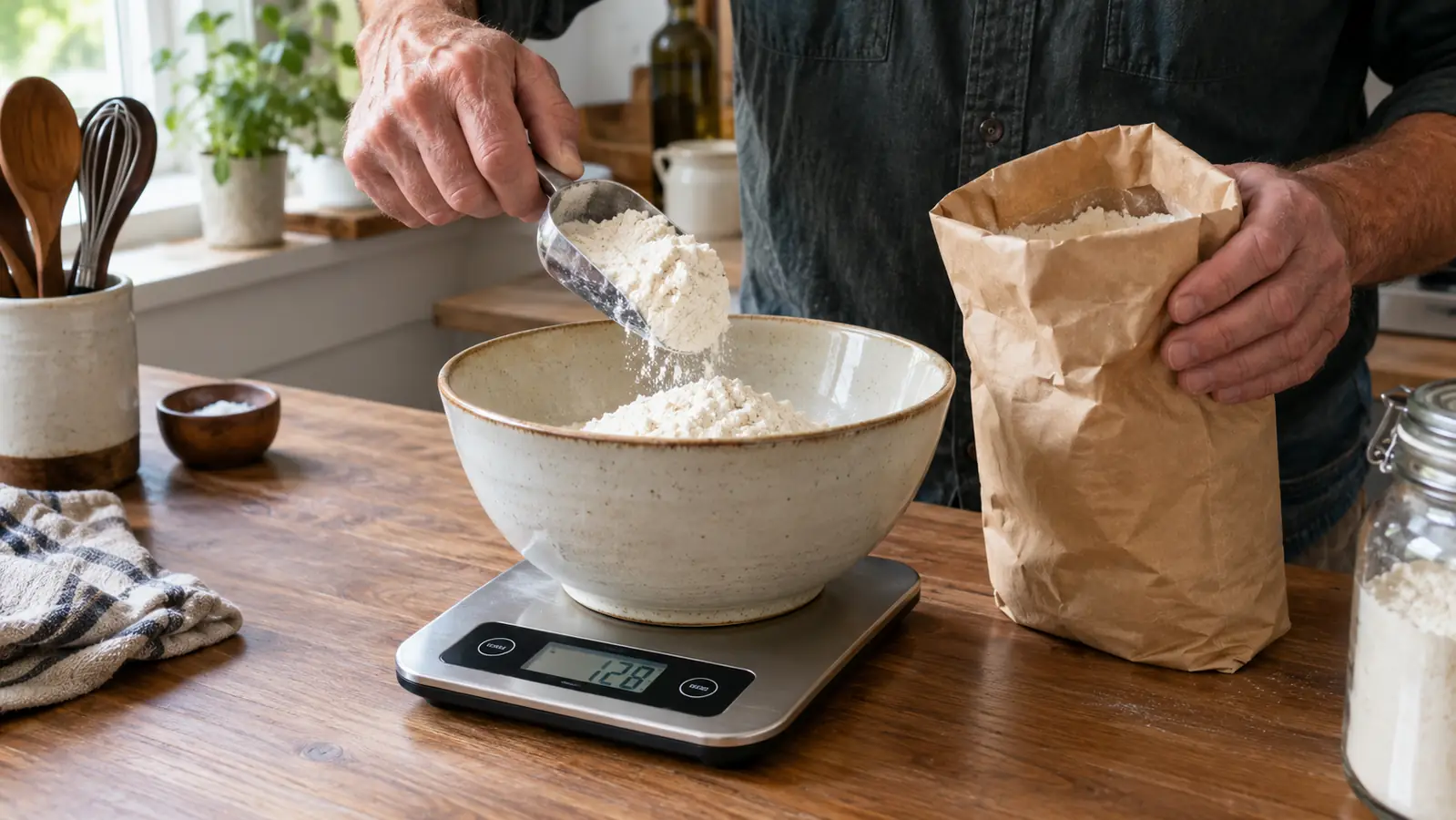
The reason the Primo wins for baking is the 1 gram accuracy, and that is not a spec sheet number. It is the difference between a recipe working and a recipe working every time. A cup of all-purpose flour can weigh anywhere from 120 to 150 grams depending on how you scoop it, whether you fluff it first, and how humid the day is. That 20 to 30 gram swing changes how much liquid the dough absorbs, which is exactly how one batch of cookies turns out perfect and the next one spreads into a puddle. When I weigh flour to 250 grams, I get the same dough every time, and the Primo makes that a two-second job: set the bowl on the scale, press tare, scoop until the display reads 250.
The tare function is the feature I did not expect to love. I put the mixing bowl on the scale, press the button, add the flour, tare again, add the sugar, tare again, and work my way down the ingredient list. One bowl, no stack of dirty cups, and if I overpour the sugar by a few grams I can scoop the extra out and watch the number come back down. That is something cups simply cannot do. With cups, an overpour means you start over or you guess. With the scale, it means a quick correction and the recipe is still exact.
The details matter too. The control panel is sealed, so a dusting of flour or a drip of vanilla does not get into the buttons. The auto shut off means I do not have to remember to turn it off. The LCD display is easy to read even when I have flour on my glasses. It reads up to 11 pounds, which covers every batch I bake, and the whole scale weighs 431 grams itself, so it is easy to lift out of the drawer and set on the counter. Escali lists it for food, packages, and envelopes, and I have used it for all three, but in my kitchen it earns its place doing one job: making the flour come out the same every time.
Bread is where weighing stops being a nice idea and becomes the whole point. A sourdough recipe that calls for 500 grams of flour and 350 grams of water is simple math when you weigh. With cups, I was guessing at hydration and then wondering why the crumb came out dense. Once I started weighing, the same recipe came out the same loaf every single time, and that is the feeling every baker is actually chasing.
The same cup of flour weighed 120 grams one Tuesday and 150 the next Saturday. That 30 gram swing is why one batch spreads and the next one does not.
Where Measuring Cups Win
Measuring cups are not useless, and I would not throw mine out. They win the jobs a scale is clumsy at. Liquids are the big one. A glass cup with a spout and a pour line is faster for a cup of milk or water than setting a bowl on the scale, and I can read the line at eye level without bending down. Cups also win on learning curve. My daughter Nora can scoop a cup of flour without thinking about it. The first time I handed her the scale, she had to learn the tare button and remember to check that the display read zero before she started.
Cups do not need batteries, which matters more than you would think the morning the scale runs out of power mid-recipe. They survive being dropped, they go in the dishwasher without a second thought, and if one disappears into a school bake sale box, replacing it costs almost nothing. For cooking, where a little more or less flour is not a crisis, cups are genuinely fine. I still reach for them when I am making a roux or a quick sauce and the exact number does not matter. The honest version of this comparison is that cups are not bad tools. They are just the wrong tool for the job baking actually needs.
Ready to stop guessing why your cookies changed?
If the batch-to-batch lottery sounds familiar, the Escali Primo takes the guesswork out of the bowl. One gram at a time, tare by tare.
Amazon Check Today's Price on Amazon →Who Should Buy Which
Buy the Escali Primo if you bake bread, cakes, or cookies more than once a month and you have ever wondered why the same recipe gives different results. Buy it if you want to scale a recipe up for the bake sale or down to a single loaf, because weighing makes the math trivial. Buy it if you are tired of washing four cups for one batch of banana bread, or if you have a recipe from a baker you trust and you want to make it the way they actually make it.
Keep measuring cups on the shelf if you bake rarely, if you mostly cook rather than bake, or if you genuinely do not care whether the cookies match last week's batch. There is no shame in that. Baking is a hobby, not a test, and the right tool is the one you will actually use. My cups still live in the drawer. The Primo lives on the counter, because it is the tool I reach for every time the oven preheats.
How I Use Both in One Kitchen
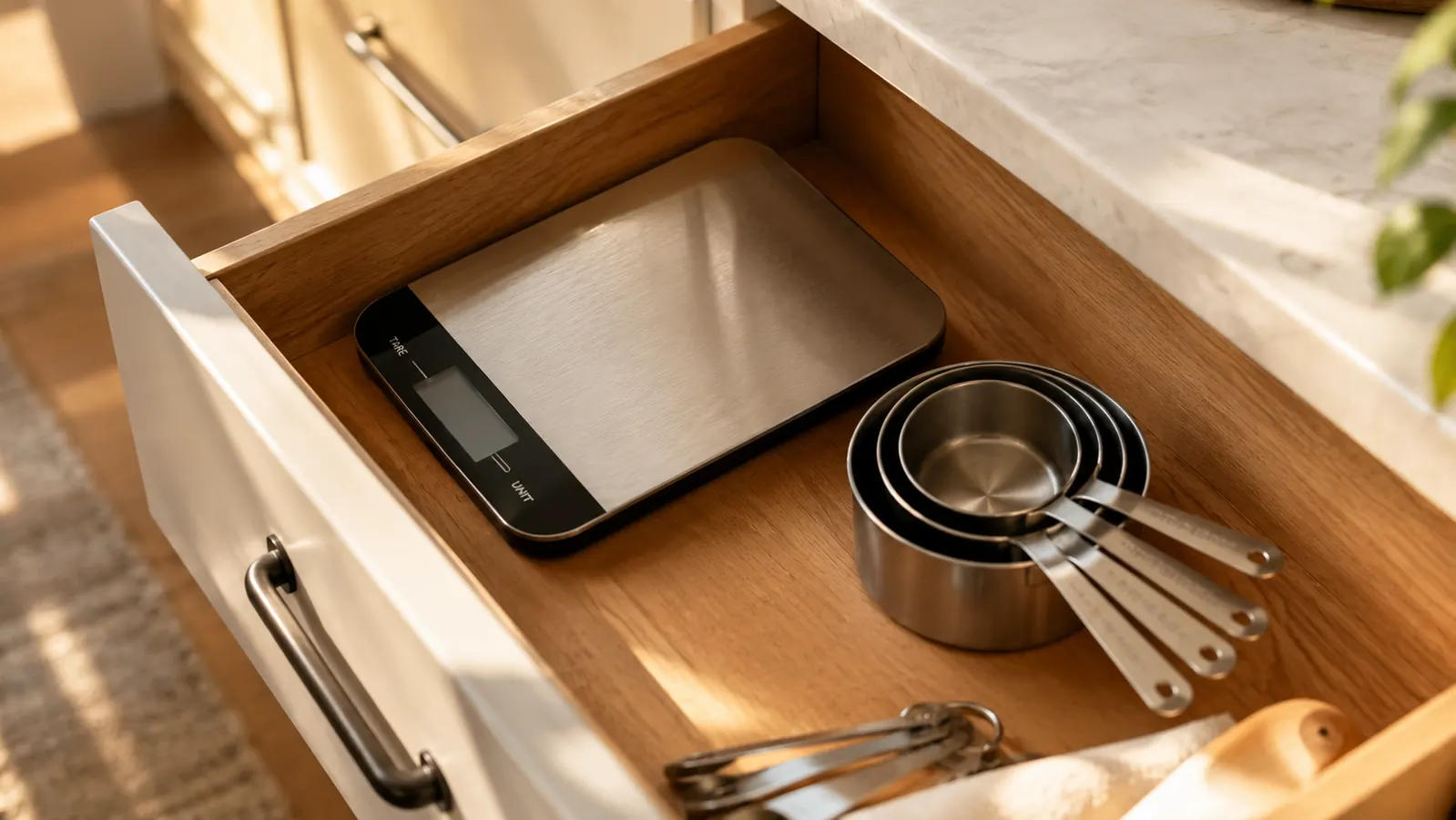
In practice, my kitchen runs a simple division of labor. The scale handles anything dry and anything where the recipe gives gram measurements. The cups handle liquids and the quick cooking where I am not following a recipe at all. When I make pancakes on a Saturday morning, I weigh the flour and the milk in the same bowl, tare between them, and pour. When I make a vinaigrette, I grab the glass cup and do not bother with the scale at all. Neither tool is the enemy of the other.
The only rule I actually follow is this: if a recipe gives weights, I use weights. If it gives cups, I use cups, and I do not stress about it. The mistake is mixing methods, scooping flour into a cup for a recipe that was written in grams, or eyeballing a weighed ingredient. Pick one system for the recipe and stay with it. That single habit fixed more of my baking than any new pan ever did.
What a Year of Weighing Taught Me
The first thing I learned is that the scale does not slow you down. I assumed weighing would add steps, but it removes them. I used to scoop flour into a cup, level it with a knife, and hope. Now I put the bowl on the scale, tare, and scoop until the number lands. It is faster, and it leaves one bowl dirty instead of four. The second thing I learned is that I had been compensating for inconsistency without knowing it. I would add an extra tablespoon of flour when the dough felt sticky, then wonder why the texture changed. Once the flour was consistent, the rest of the recipe fell into line.
The third thing surprised me. My kids started using it. Ben, who is thirteen and would rather be doing anything else, weighs his own ingredients for pancakes now, because the scale tells him exactly when to stop. Nora uses it for the bake sale and has started converting her favorite recipes to grams on her own. A scale is not just more accurate than cups. For a certain kind of cook, it is easier, because it removes the judgment call that cups quietly require.
What to Know Before You Buy
The Primo is a two-button scale. One button turns it on and off, the other handles tare, and that is the whole learning curve. The control panel is sealed, which is worth more than it sounds like in a kitchen where flour hangs in the air. The LCD display is clear, and the auto shut off means the scale turns itself off when I get distracted and walk away. There is no app, no complicated mode, no setup. It does one thing and does it well.
The capacity is 11 pounds, which is plenty for home baking, and the readout is accurate to 1 gram, which is the number that matters for baking. The whole scale is 431 grams, so it is light enough to move around but solid enough to stay put while you scoop. Escali makes the Primo in a range of playful colors, so it is easy to find one that fits your kitchen, and it carries a 5-year limited warranty, which tells me the company expects it to last.
The Bottom Line
The bottom line is simple. The Escali Primo does not make you a better baker. It makes you a more consistent one, and consistency is what every recipe is really asking for. It reads to the nearest gram, tares between ingredients, wipes clean, and tucks away without a fuss. My measuring cups are still in the drawer for liquids and quick sauces. But for the baking that matters, I weigh every time, and my cookies finally match the ones from last week.
Give your next batch the same flour twice
The Escali Primo reads to the nearest gram, tares between ingredients, and cleans up in seconds. If that sounds like the fix your baking has been waiting for, it probably is.
Amazon Check Today's Price on Amazon →