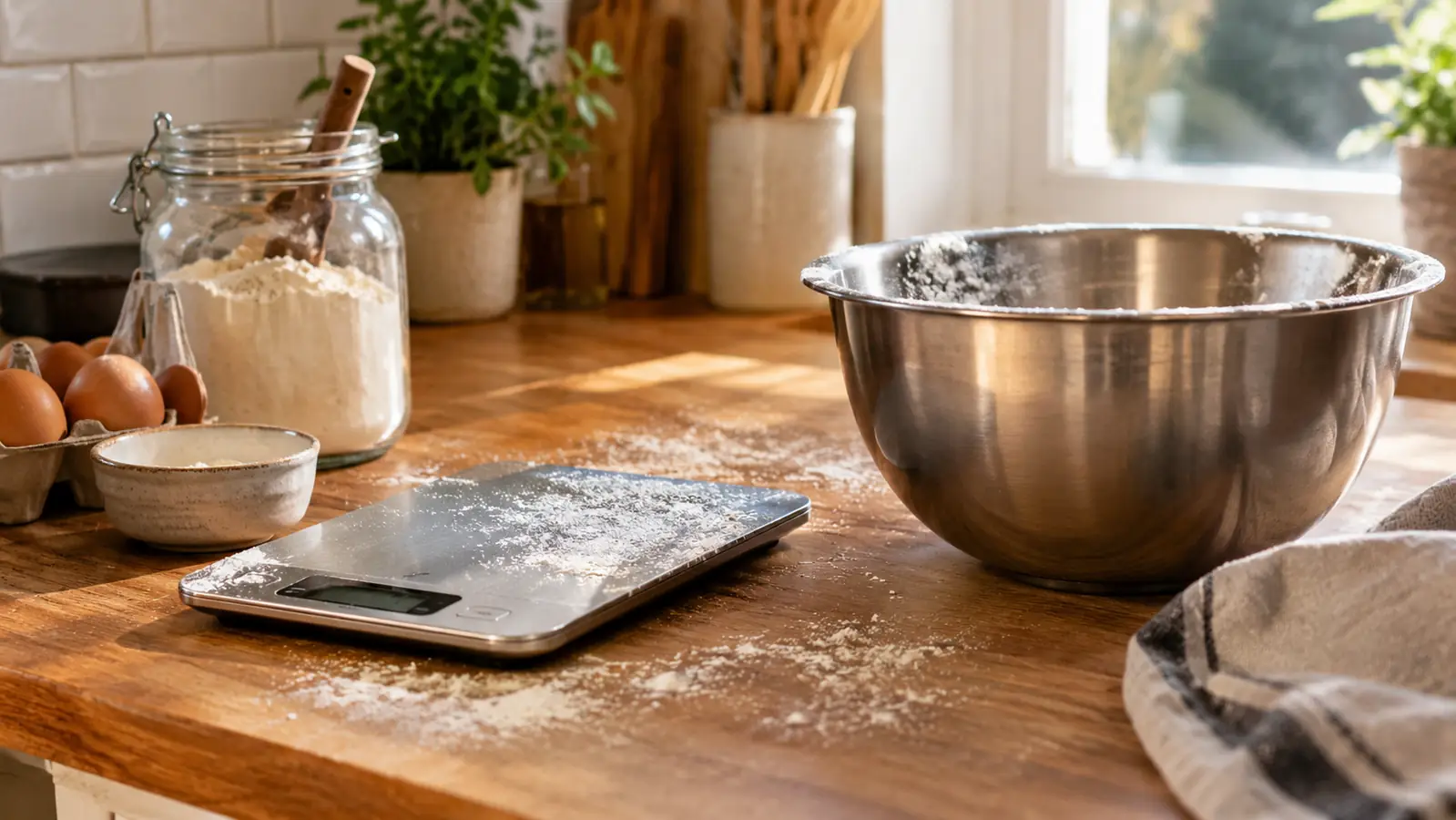
I bought the Escali Primo Digital Food Scale about a year ago, after a particularly flat batch of chocolate chip cookies made me wonder if my flour scooping was the problem. It was. The Escali Primo is a small digital counter scale with a two-button setup, a tare function, and a sealed control panel that wipes clean with one pass of a dish towel. It reads to the gram, handles up to 11 pounds, and shuts itself off when I forget about it, which is often.
I am not a precise baker by nature. For fifteen years I measured flour the way my grandmother did, with a cup dipped into the bag and leveled with a knife. Then I started making bread that called for 500 grams of flour, and my grandmother's method stopped being charming. A cup of flour can weigh anywhere from 120 to 150 grams depending on how it settles, how humid the day is, and whether I tapped the cup. That range is the difference between a soft dinner roll and a hockey puck. So I bought a scale, and I bought this one because it was simple, because it had the features I actually needed, and because Escali has a reputation among home bakers for making no-nonsense tools.
The Quick Verdict
A simple, accurate scale that does exactly what a home baker needs and nothing extra. The two-button design is the feature, and a year in, mine still reads to the gram.
Amazon Check Today's Price →The scale I reach for every baking morning
The Escali Primo reads to the gram, tares in one press, and has survived a year of weekly baking on my counter. If you bake more than once a month, this is the scale I would start with.
Amazon Check Today's Price on Amazon →How I've Used It
For the past year, the Escali Primo has lived on the counter between the toaster and the knife block. It is not a showpiece. It is the thing I use before the oven even preheats, and it has been through more flour, sugar, cocoa, peanut butter, and honey than I can count. I use it for the obvious baking jobs: weighing flour for bread, portioning dough for rolls, measuring brown sugar for cookies, and checking that I have not overdone the chocolate chunks.
I also use it for the less obvious jobs. I weigh out yeast for a sourdough starter, weigh water when I am being fussy about hydration, and weigh the little disks of dough for the school bake sale so the cookies come out even. When I make granola, I put the bowl on the scale, hit tare, and add oats, then nuts, then dried fruit, all into the same bowl without washing anything in between. That is the tare function doing its job, and it is the reason I stopped reaching for measuring cups.
During the school year, I bake most weeks on Sunday morning and sometimes on a Tuesday night after work. The scale sits out, gets flour on it, gets a quick wipe, and goes back to work. I have never once worried about getting it wet, because the control panel is sealed and the whole thing is easy to clean. That matters more to me than any other feature on the list.
I also use it for things that have nothing to do with baking. Escali lists it for envelopes, food, and packages, and I have used it for all three. When I need to know if a stack of envelopes will fit through the mail slot, or when I am portioning out dried beans for a camping trip, the scale is right there on the counter. It is the most-used tool in my kitchen, and I did not expect that.
Why I Switched to Weighing Flour
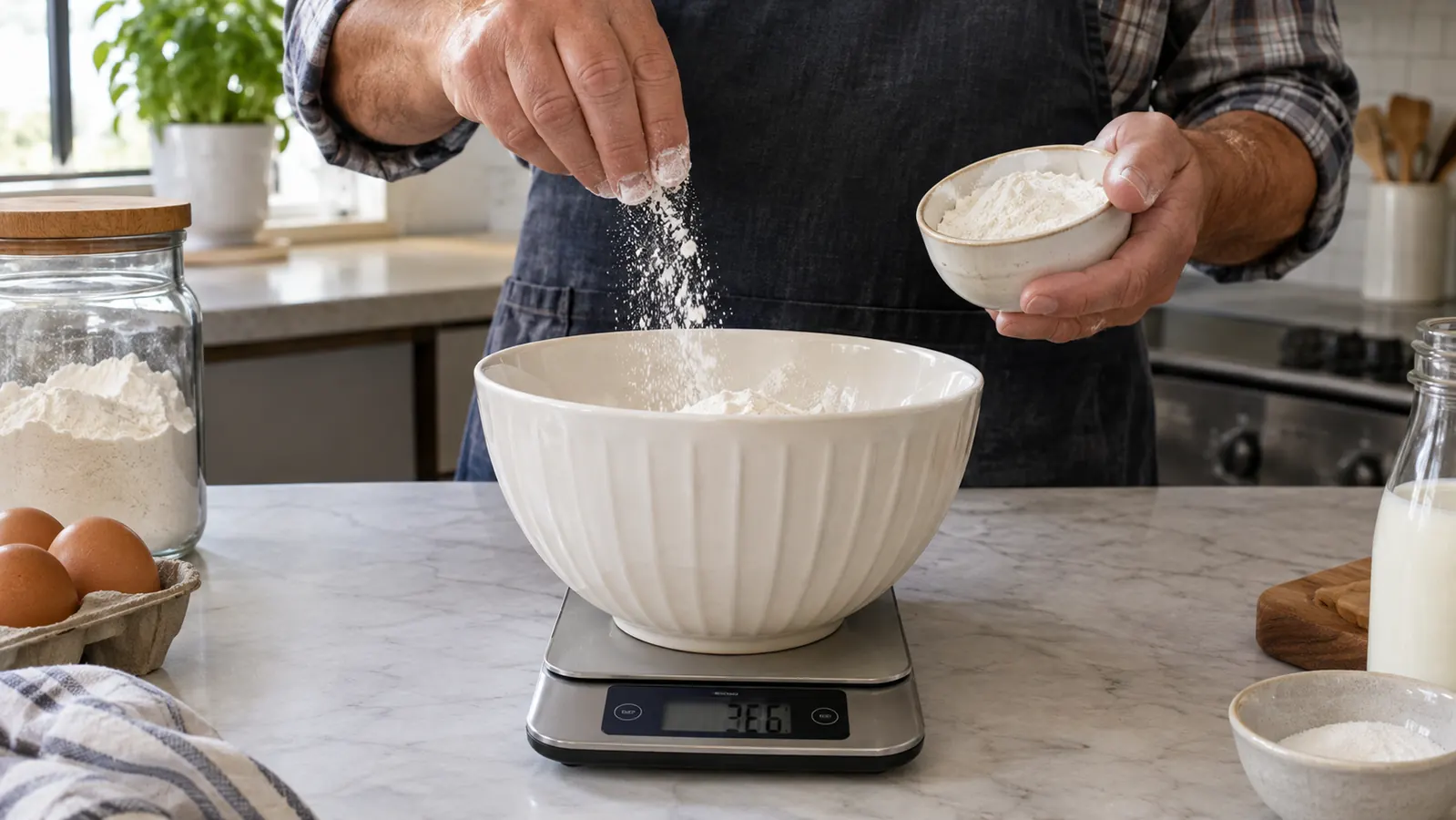
The short version is that measuring flour by volume is a gamble. When I scoop a measuring cup into a bag of flour, I can pack in anywhere from 120 to 150 grams depending on the day. When I weigh 250 grams of flour, I get exactly 250 grams every single time. For bread, that is the difference between a dough that rises and a dough that turns into a brick. For cookies, it is the difference between a batch that spreads evenly and a batch that comes out half flat, half puffy.
I did not switch because I wanted to be a more serious baker. I switched because I was tired of inconsistent results. The Escali Primo made the switch easy because it is not fussy. You put a bowl on it, press the button to zero it, add flour until the display reads what the recipe says, and go. It reads to the gram, which is precise enough for everything I bake, and it handles up to 11 pounds, which covers every batch that fits in my standard oven.
The other thing I learned is that weighing works for more than flour. Brown sugar, which packs down in a measuring cup, is far more reliable by weight. Honey and molasses are easier to measure into a bowl on a scale because they do not stick to a measuring cup. Even water is simpler to weigh, since a gram of water is a milliliter, and I do not have to wash a liquid measuring cup. The scale turned out to be a shortcut, not an extra step.
If you are used to cups, the first week feels strange. You will find yourself reaching for the measuring cup out of habit, then putting it back. After a week, you will wonder why you ever scooped. I still keep a set of measuring cups in the drawer for the kids, but for anything I care about, the scale is what I use.
What the Two Buttons Actually Do
The Escali Primo has two buttons, and that is the whole interface. One button turns the scale on and zeros it. The other is the tare button, which resets the display to zero with whatever is already on the scale. That means you can weigh a bowl, add flour, tare, add sugar, tare, add cocoa, and end up with one bowl of perfectly measured dry ingredients and exactly one bowl to wash.
It also has an auto shut-off, which I appreciate more than I expected. I am the kind of cook who walks away mid-recipe to check on the kids or answer the door, and I have killed more than one kitchen gadget by leaving it on. The Primo turns itself off when I forget it, and it does not hold a grudge. The display is a simple LCD, clear enough in good light, and the whole thing weighs about 431 grams, so it is easy to move from counter to counter.
The sealed control panel is the detail I did not think I would care about. Flour gets everywhere, and I am not the kind of baker who wipes down every surface the second I finish measuring. With the Primo, I can wipe the face with a damp cloth and not worry about water working its way into the electronics. It is a small thing, but it is the difference between a tool that lasts and a tool that gets finicky.
How It Holds Up After a Year
A year of weekly use is a fair test for a kitchen tool, and the Escali Primo has passed it. The sealed control panel still looks new, even after being dusted with flour and wiped with a damp cloth more times than I can count. The tare button still feels crisp. The display still reads to the gram, and I have not noticed any drift in accuracy. I check it now and then against the little calibration weights I use for shipping packages, and it is always right on.
The plastic body is light, which is fine for a scale that lives on a counter. I would not want to drop it on a tile floor, but I have not dropped it, and I do not treat it like fine china. It is the kind of tool that disappears into the routine, which is the highest compliment I can give a piece of baking equipment. It does its job, it does not demand attention, and it has never once made me second-guess a measurement.
The only maintenance I have done is wiping it down and occasionally moving it to reach the toaster. The auto shut-off means I do not think about power, and the warranty gives me some peace of mind if something does go wrong. Escali may not be the flashiest brand on the shelf, but after a year, mine is still working like it did on day one.
My daughter Nora uses it when she bakes, and my son Ben has used it for a school project that involved weighing small objects. It has survived being handled by teenagers, which is not nothing. The buttons are simple enough that nobody has to ask me how to use it, and that is exactly what I want from a kitchen scale.
Where It Comes Up Short
No tool is perfect, and the Escali Primo has a few honest limitations. The first is capacity. It handles up to 11 pounds, which is plenty for my baking, but if you regularly weigh a huge batch of dough or a big stockpot full of ingredients, you will bump against the limit. I have never hit it, because my standard oven cannot hold anything that big anyway, but it is worth knowing.
The second is the display. The LCD is clear, but it is not huge, and in low light I sometimes have to lean in to read it. It is not a problem in my kitchen, where the counter gets good morning light, but if you bake in a dim corner, you may find yourself squinting. The third is the plastic body. It is light and easy to move, but it does not feel as substantial as a metal scale might. That has not affected how it works, and I would rather have light and accurate than heavy and pretty.
None of these are dealbreakers for me. I mention them because a review that only talks about the good parts is not a review. The Escali Primo is a simple scale, and its limitations are the same as its strengths. It does not try to be more than it is, and for most home bakers, that is exactly right.
Alternatives I Considered
Before I settled on the Escali Primo, I looked at a few other options. There are scales with pull-out displays, scales that measure in fractions of an ounce, and scales that cost several times as much. I almost bought one with a bigger screen, but then I thought about how I actually bake. I do not need a scale that talks to my phone. I need a scale that zeros a bowl, reads to the gram, and does not make me wash extra dishes.
I also considered just sticking with measuring cups, since they are what I grew up with and what most of my recipes are written in. But the more I weighed ingredients, the more I realized that cups were the reason my baking was inconsistent. The Escali Primo is not the most expensive scale, and it is not the most feature-packed, but it is the one that gets used, and that is the metric that matters.
If a friend asked me what to buy, I would tell them to start here. Not because it is the most impressive scale in the store, but because it is the one most likely to actually get used. A scale that sits in a drawer is useless no matter how many features it has. The Primo earns its spot on the counter, and that is the whole point.
What I Liked
- Reads to the gram, so recipes come out the same every time
- Two-button operation means there is nothing to learn
- Tare function lets you measure multiple ingredients into one bowl
- Sealed control panel wipes clean in one pass
- Auto shut-off means I never have to remember to turn it off
- Light enough to move around the kitchen without thinking about it
Where It Falls Short
- 11-pound capacity is plenty for me, but not for huge batches
- Plastic body feels light and not particularly fancy
- LCD display is clear but small, and I sometimes lean in to read it
- No bells and whistles, which is the point, but some people will want more
A year in, mine still reads to the gram, tares in one press, and has never once made me guess.
Who This Is For
The Escali Primo is for the home baker who is tired of inconsistent cookies and flat bread and who wants a scale that simply works. It is for the person who bakes banana bread on Sundays, makes pizza dough on Fridays, and wants to stop scrubbing measuring cups. It is for anyone who has ever looked at a recipe that calls for 250 grams of flour and thought, "I could just weigh that." Yes, you can, and this scale makes it easy.
It is also for the person who does not want to think about their tools. There is no learning curve. You put a bowl on it, press a button, and weigh. If that sounds like the kind of kitchen tool you want, the Escali Primo is a very good fit.
If you are still deciding between cups and a scale, I would say try weighing your next batch of cookies. Use the scale for the flour, keep using cups for the vanilla if that is easier, and see if the results feel more consistent. I think you will notice the difference in the first batch. That is what happened to me, and it is why the scale has stayed on the counter for a year.
Who Should Skip It
If you bake once or twice a year and are happy with the results you get from measuring cups, you do not need this scale. There is nothing wrong with scooping flour if it works for you. If you regularly weigh more than 11 pounds of ingredients at once, you will want a scale with a higher capacity. And if you want a scale with a big backlit display, a pull-out screen, or a more premium feel, the Primo's simple plastic body may leave you wanting more.
None of those are reasons to avoid the Escali Primo. They are just reasons to be honest about what you need. For me, the simple two-button scale has been the right tool for a year of weekly baking, and I expect it will be the right tool for the next year too.
One more note: if you are shopping for a gift for a baker who already has a scale they love, this is probably not the gift they need. But if you are buying for someone who has been complaining about flat cookies or dense bread, the Escali Primo is a thoughtful, practical present that they will actually use.
Ready to weigh your flour instead of guessing?
After a year, the Escali Primo is still the first thing I reach for on baking mornings. If that sounds like the kitchen you want, this is a good place to start.
Amazon Check Today's Price on Amazon →