I trusted my oven dial for years. Every recipe said 350, I set the dial to 350, and I assumed that was the end of the conversation. Then my grandmother's sugar cookies started coming out pale in the middle and dark on the bottom, and no amount of rack shuffling fixed it. So I bought a Taylor Analog Oven Thermometer, set it on the middle rack, and found out my oven had been running about 25 degrees cool the whole time.
Here is the short answer: a Taylor oven thermometer is a small, inexpensive tool that tells you the actual temperature inside your oven, and the dial is a guess that was never calibrated to your particular oven. If you bake even once a week, the thermometer wins. The dial only wins in one situation, and I will get to that.
| Taylor Oven Thermometer | Oven Dial | |
|---|---|---|
| What it measures | Actual air temperature on the rack where your food sits | A number printed on a knob that may not match reality |
| Accuracy | Reads from 100 F to 600 F with a large, easy-to-read dial | Often 10 to 50 degrees off, and the error changes at different temperatures |
| Setup | Set it on the rack, wait a few minutes, read it | Nothing to set up, which is exactly why it never gets checked |
| Cost to replace | Inexpensive to replace, built with stainless steel | A new oven, or an expensive service call |
| Best for | Any baker who wants consistent cookies, cakes and bread | Someone who has already verified their oven runs true |
Find out what your oven is actually doing before your next batch
One Taylor thermometer on the rack tells you in five minutes whether your dial is lying. It is the cheapest baking upgrade I own.
Amazon Check Today's Price on Amazon →How I Tested Both
I ran the comparison over about six weeks of ordinary baking, not a laboratory setup. The morning that pushed me over the edge was a Saturday in late January. I had a double batch of my grandmother's sugar cookies in the oven, the same recipe I had baked every Christmas for fifteen years, and the edges were browning while the centers stayed pale and raw. I rotated the pan, moved it up a rack, then down a rack, and added two minutes, then three more. Nothing helped, because the problem was never the rack position or the bake time. It was the temperature.
Before I bought the Taylor thermometer, I tried everything except the obvious thing. I blamed the cookie sheet, so I bought a new one. I blamed the flour, so I switched brands. I even blamed myself for overmixing, which is what every baking article told me to do. It never occurred to me that the oven itself was lying, because the dial said 350 and the oven beeped its preheat tone like it always did.
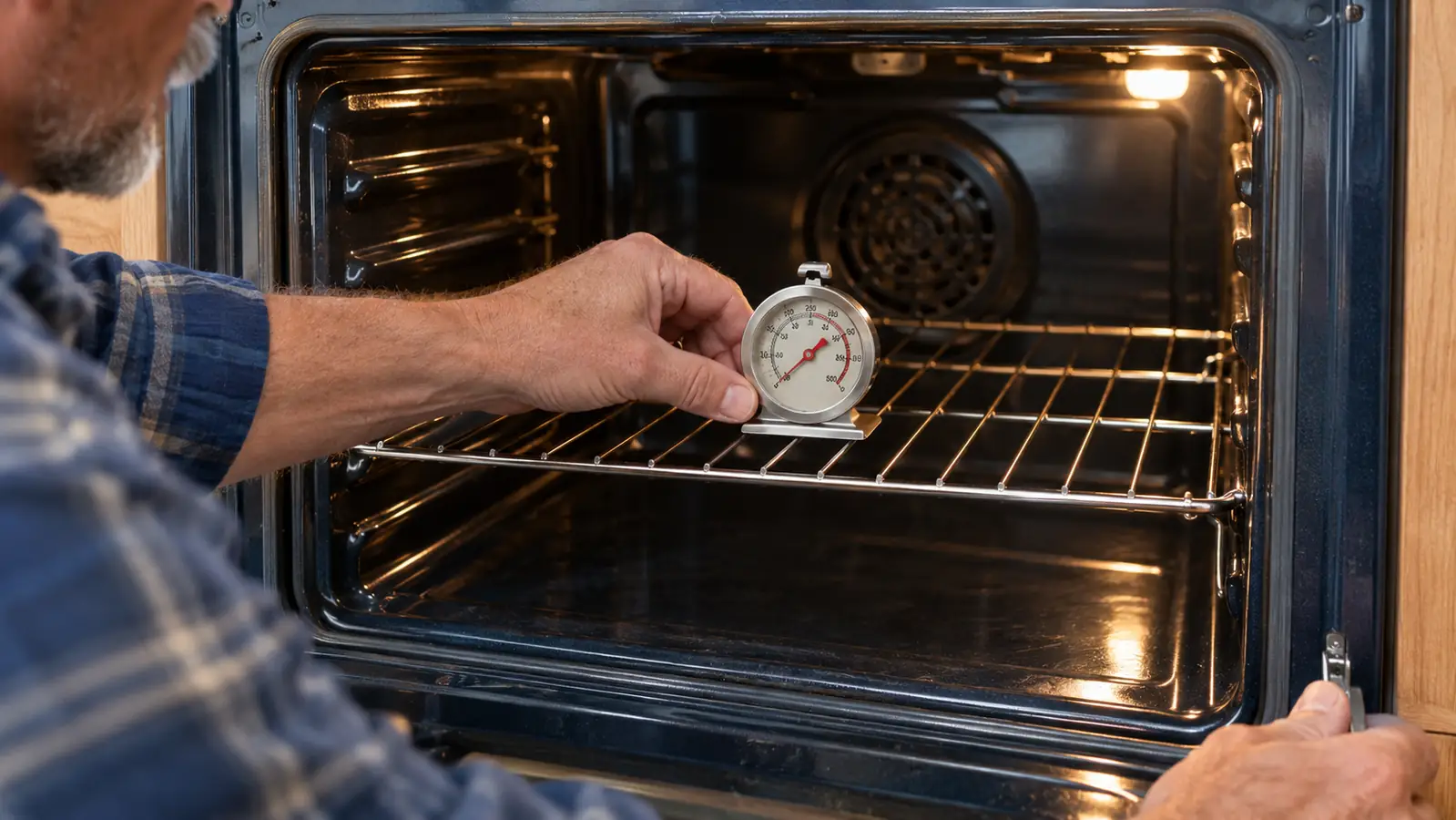
I set my oven to 350, waited for the preheat tone, then placed the Taylor thermometer on the center of the middle rack and gave it ten minutes to settle. The first time I did this, the thermometer read 325. I checked the dial, checked the racks, and blamed the thermometer for about four minutes before I moved it to a different spot and got the same number. I let it sit another five minutes and it still read 325.
I repeated the test at 400 for roasting vegetables and at 425 for bread. My oven ran cool at every setting, though the gap was not identical each time. At 400 it read 370, and at 425 it read 395. That is the part that makes baking hard: the error is not a flat 25 degrees you can memorize. It shifts with the temperature, with how long the oven has been on, and with how much cold food you just put inside. A tray of cold cookie dough straight from the fridge can drop the air temperature by twenty degrees in the first minute, and the dial has no idea that happened.
The Taylor thermometer itself was easy to live with. It is 2.88 ounces, so it does not tip over on the rack. The large, colorful dial with marked zones is readable through the oven door, which means I stopped opening the oven to check. It is battery powered with a fast reading system, and the response time of 500 milliseconds meant I got a stable number quickly. The instruction manual says not to put it in the dishwasher, so I wipe the stainless steel body with a damp cloth and it looks the same as the day I bought it. It reads from 100 F to 600 F, which covers every temperature I have ever needed in a home oven.
I also learned that the thermometer earns its keep at the edges of the range, not just at baking temperatures. When I set the oven to 250 for a slow braise, the thermometer read 225. When I set it to 450 for pizza night, it read 420. The dial was optimistic at every setting, overstating the heat by 25 to 30 degrees, which meant my braises took longer than the recipe said and my pizza crusts needed more time than I expected. A recipe writer tested their bread in an oven that was probably closer to true, and my oven was not that oven.
Where Taylor Wins
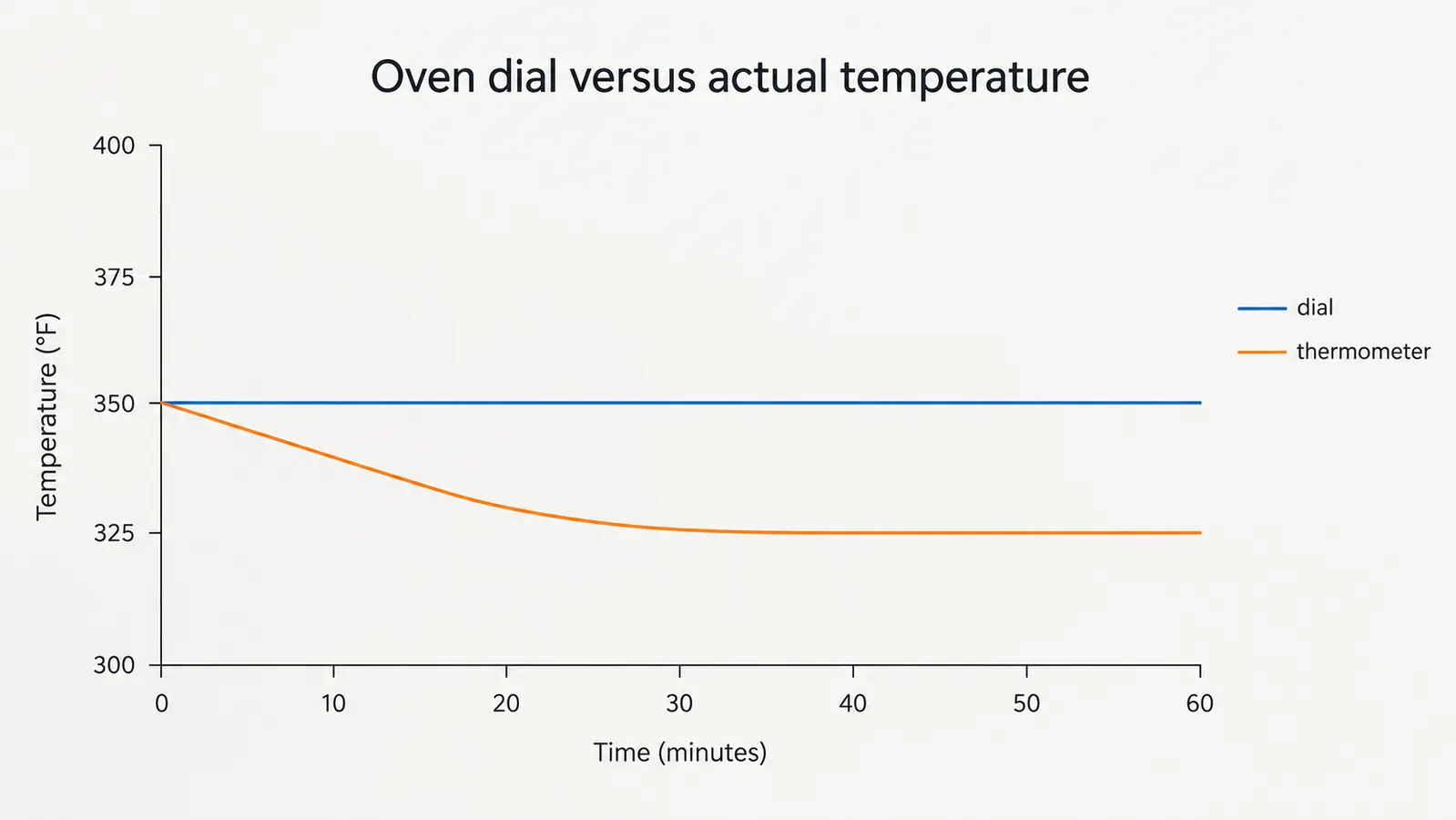
Taylor wins on the only thing that matters in baking: knowing the real temperature. My dial said 350 while the thermometer said 325, which explained every pale cookie and underdone cake center I had blamed on my own baking. Once I started setting the dial to 375 to get a true 350, my results changed in one weekend. The next batch of sugar cookies baked in the time the recipe actually specified, spread the way they were supposed to, and came out golden instead of pale with burnt edges.
The proof showed up in the things I had stopped even trying. Nora's birthday cake, which I had been making for years and accepting as fine, came out level for the first time in recent memory, no sunken middle, no gummy ring at the bottom. Ben's favorite sandwich bread rose higher and baked through instead of collapsing when I tapped the top. My grandmother's recipes, which I had assumed needed updating, turned out to be exactly right. The oven was the one that had been wrong.
Taylor also wins on cost and on peace of mind. A thermometer is inexpensive, takes up almost no drawer space, and gives you an answer in minutes. It is the kind of tool that pays for itself the first time it stops you from ruining a batch of ingredients. I keep mine on the middle rack year round, which means I am always baking at the temperature the recipe actually wants, and I never have to wonder whether the oven has drifted since last month.
There is also a quieter win that surprised me: I stopped second-guessing my oven during the school bake sale. Twice a year I make four dozen cookies and two sheet cakes for the sale, and in the past I would pull things out early, test them with a toothpick, put them back, and still end up with a batch that was dry on one side. With the thermometer I just set the dial where it needs to be, set a timer, and trust it. The bake sale cookies came out even enough that a coworker asked if I had started buying them from a bakery.
Where the Dial Wins
The dial wins in exactly one honest way: it requires nothing. It is already there, it never needs to be moved, and you never have to remember to use it. For the first ten years I baked, the dial was all I had, and I made perfectly good banana bread, sheet cakes, and holiday cookies without ever questioning it. If you have already verified that your oven runs true, or you only bake from mixes where an extra 25 degrees does not matter, the dial is fine. I do not want to pretend the thermometer is a necessity for someone who bakes a frozen pizza every other week.
The dial also wins on durability in the sense that it cannot be lost, knocked off a rack, or forgotten in a drawer. It has no battery to die and no glass to crack. My Taylor thermometer lives on the rack, so this has not been an issue for me, but I understand the appeal of a tool with no moving parts and no maintenance. If your oven has been professionally calibrated and you trust it completely, you do not need my thermometer lecture. The dial is also the right answer for a kitchen you will not be in for long, where buying a thermometer for someone else's oven feels like a waste.
My dial said 350 while the thermometer said 325. That single number explained every pale cookie and underdone cake I had blamed on myself.
What the Dial Gets Wrong
The problem with the dial is not that it is evil. It is that it was never calibrated to your oven. The number printed on the knob is whatever the factory set it to, and it does not account for your oven's age, its insulation, how the heating element cycles, or where you place your pans. Mine is a standard electric oven that came with the house, and it has its own personality that has nothing to do with the numbers on the front. An oven that runs cool at 350 may run hot at 450, so there is no single correction you can memorize. In my oven the gap was 25 degrees at 350 and 30 degrees at 400 and 425, which means a chart would have helped, but a thermometer made the chart unnecessary.
The other thing the dial gets wrong is that it measures the knob, not the air. Your food does not care where the knob points. It cares about the temperature of the air around it, and that air temperature changes every time you open the door. The first time I watched the thermometer drop from 350 to 300 when I opened the oven to rotate a pan, I understood why my scones had been spreading instead of rising. A thermometer on the rack shows you the recovery, which is why I now wait for the thermometer to come back to temperature before I slide in a tray of scones. It adds about four minutes to the start of a bake, and it is the difference between flat disks and tall, craggy tops.
The last thing the dial gets wrong is the quietest and the most expensive: it erodes your confidence in your own baking. For years I thought I was an inconsistent baker, because the same recipe would work one week and fail the next. I changed my technique, my ingredients, my pans. I never changed the one variable that was actually broken. When the thermometer showed me the oven was the problem, all those failed batches suddenly made sense, and I stopped apologizing for my baking at potlucks.
Who Should Buy Which
Buy the Taylor thermometer if you bake bread, cakes, cookies, or anything where a 25 degree difference changes the outcome. That includes anyone starting to take baking seriously, because the thermometer will teach you how your oven actually behaves. It is also a good buy if you have moved recently, since a new oven is a new personality and the thermometer will introduce you to it.
Skip the thermometer and keep trusting the dial if you bake rarely, if you have already verified your oven with a thermometer and know it runs true, or if you simply do not care about the difference between a good batch and a great one. There is no shame in that. But if you are here, reading a comparison of oven thermometers, you are probably the kind of baker who would rather know.
One more thing worth saying: the thermometer is not a replacement for learning your oven, it is a way to learn it faster. I kept notes for the first month, a simple list taped inside the cabinet door above the oven, with the dial setting on one side and the thermometer reading on the other. By the end of that month I knew that 375 on the dial means 350 on the rack, and I could have gone back to trusting the dial with that knowledge. I did not, because the thermometer also catches the days when the oven misbehaves, and it takes no effort to leave it in place.
Know your oven before your next bake
A Taylor thermometer on the rack is the fastest way to turn guesswork into consistent results. My only regret is waiting years to buy one.
Amazon Check Today's Price on Amazon →