

I bought the Taylor analog oven thermometer because my oven was lying to me. Not on purpose, but it was lying. The dial said 350 degrees, and the cake said otherwise, and for a while I blamed the cake, then the recipe, then myself. Finally I blamed the oven. So I ordered the Taylor, set it on the middle rack, and let it tell me the truth about what happens inside a standard electric oven when the door closes.
Here is what nobody tells you before you buy an oven thermometer: it will not fix your oven. It will only show you what your oven actually does. That sounds like the same thing, but it is not. A thermometer cannot make the temperature even or make the dial honest. It just gives you a number you can trust, and then you get to decide what to do with that number. For me, that changed everything. I have now used it for over a year, and I still feel the same way.
The Quick Verdict
The Taylor analog oven thermometer is a simple, durable tool that tells you the real temperature inside your oven. It has a coarse dial and it will not fix a broken oven, but it will make you a better baker by showing you the truth.
Amazon Check Today's Price →The thermometer that showed me what my oven actually does
If your oven dial is a suggestion rather than a fact, this is the fix. It sits on the rack, shows you the real temperature, and has been doing it in my kitchen for over a year.
Amazon Check Today's Price on Amazon →How I've Used It
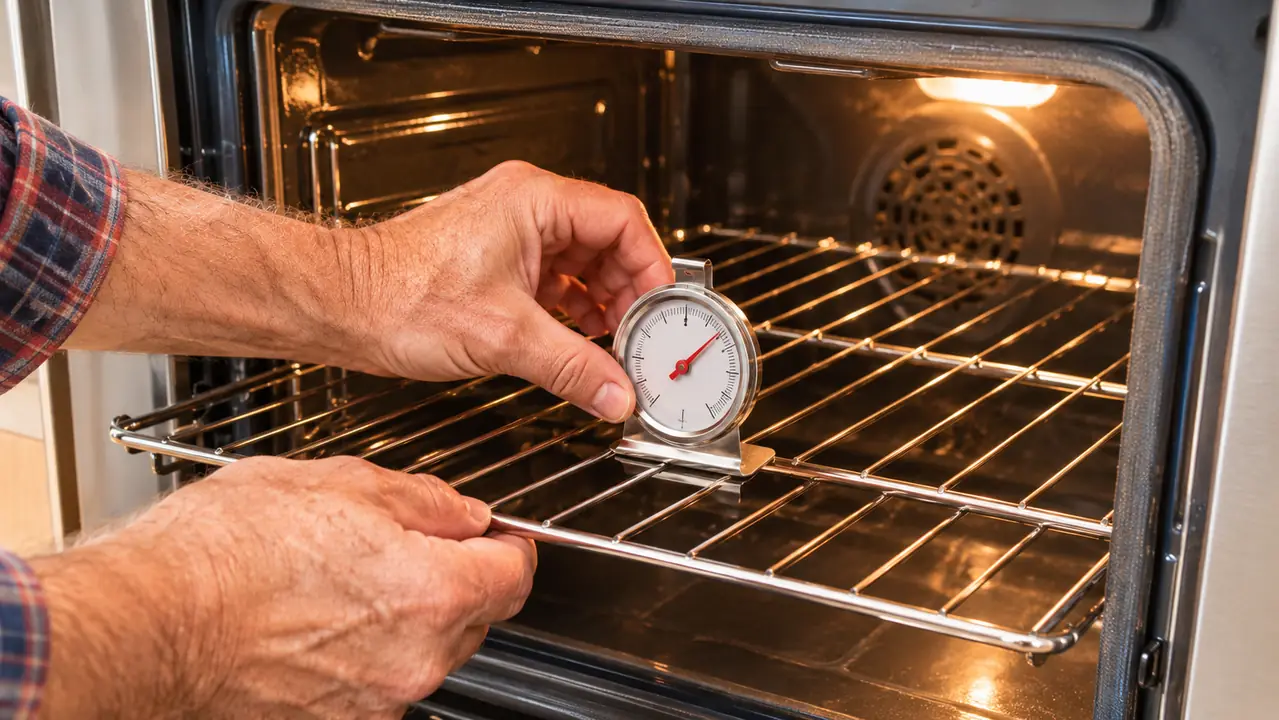
I have used this thermometer for about a year and a half, which makes it one of the most-used tools in my kitchen. I bake at least once a week, usually more. Banana bread for the school bake sale, cookies for my kids, a crusty loaf when I have the time, and a birthday cake for anyone in the house who has a birthday coming up. The Taylor goes on the middle rack before the oven preheats, and it stays there while I bake.
I do not move it much. I set it near the back, just to the left of center, because that is where I put most of my pans. When I bake something delicate, like a sponge cake or a batch of macarons, I move it closer to where the pan will sit. Then I read it through the oven door, or I do a quick open-and-look if I need to see the numbers clearly.
The instructions say not to put it in the dishwasher, so I wipe it with a damp cloth when it gets dusty. It is small, a little under three ounces, and it lives on the rack until I need the space. Then it sits on the counter until the oven cools and I put it back. That is the whole routine.
I have used it for things the manufacturer probably did not have in mind. I have used it to check the temperature of my oven before a big holiday dinner, to see whether the top rack is hotter than the middle rack, and to figure out why a batch of meringues browned on one side. It answered all of those questions. That is what I mean when I say it earns its cabinet space.
I also use it when I am roasting meat, even though I have a separate meat thermometer. The oven thermometer tells me the oven is at the right temperature, and the meat thermometer tells me the meat is done. They are different jobs, and I like having both.
What Nobody Tells You Before You Buy One
First, the thermometer will probably tell you something you do not want to hear. My oven runs about 25 degrees hot on the left side and about 15 degrees hot on the right. That is a bigger difference than I expected, and it explained a lot of my baking failures. The edges of my sheet cakes were always more done than the center, and I thought I was doing something wrong. I was not. My oven was doing something wrong, and the Taylor showed me.
Second, the dial is not as precise as you might hope. The markings are in 50 degree steps, so you are reading between the lines. For most baking, that is fine. You are usually aiming for 325, 350, or 375, and you can tell when the needle is in the right neighborhood. But if you are the kind of baker who wants an exact digital readout, this is not that tool. It is an analog dial, and it behaves like one.
Third, the temperature zones on the dial are genuinely useful. The Taylor has a large dial with marked optimal cooking zones, so you can see at a glance whether you are in the right range for whatever you are baking. I thought that was a gimmick when I bought it. It is not. When I am roasting vegetables at a high temperature, I can glance at the dial and know I am in the zone without doing mental math.
Fourth, it reads from 100 to 600 degrees Fahrenheit, which covers everything I do and then some. I have never come close to the top of the range. I have also never wished for a lower number. The range is wide enough that I do not think about it.
Fifth, the stainless steel body has held up better than I expected. It sits in a hot, humid oven several times a week, and it still looks the same as the day it arrived. The glass face has not clouded, and the markings have not worn off. I cannot say that about every cheap kitchen tool I have owned.
What I Learned About My Oven
The biggest lesson was that my oven is not one temperature. It is a collection of temperatures, and the difference from one corner to another is bigger than I ever would have guessed. I spent an afternoon moving the Taylor around the rack, waiting a few minutes at each spot, and writing down what it said. The back left corner was the hottest. The front right was the coolest. The middle, where I usually bake, was somewhere in between.
Once I knew that, I started placing my pans accordingly. Cookies go in the middle, and I rotate the sheet halfway through. Cake pans go closer to the center, and I turn them around at the halfway mark. Bread goes on the hottest side because my oven runs a little cool for a good crust. These are small adjustments, but they made a visible difference in how everything bakes.
I also learned that my oven takes longer to come to temperature than the beep suggests. The oven says it is preheated, but the Taylor says it is still climbing. I started waiting an extra ten minutes before putting anything in, and my first rise on bread dough got noticeably better. That alone made the purchase worth it.
Here is the honest part: I still open the oven to check on things, because I am a home baker and that is what I do. But I open it less, and I trust what I see more. The Taylor does not make me a patient baker. It makes me an informed one.
I also learned that the temperature changes depending on how full the oven is. A big tray of vegetables drops the temperature more than I expected, and it takes a while to come back. The Taylor showed me that recovery time is real, so I started giving the oven a few extra minutes after loading it. That has saved more than one batch of biscuits.
The last thing I learned is that my oven is not as consistent as I assumed. Some days it runs hot, some days it runs cool, depending on the weather and how long the oven has been on. The Taylor does not judge. It just reports. That consistency is exactly what I need when I am baking for other people.
My oven says 350. The Taylor says 375. That 25 degrees is the difference between a moist cake and a dry one.
The Downsides Nobody Mentions
The first downside is the 50 degree markings. When the needle sits between 350 and 400, you are guessing. For a recipe that really cares about 375, you have to decide whether to trust the guess or adjust the oven. I usually adjust the oven and then check again in five minutes. It works, but it is not as clean as a digital readout.
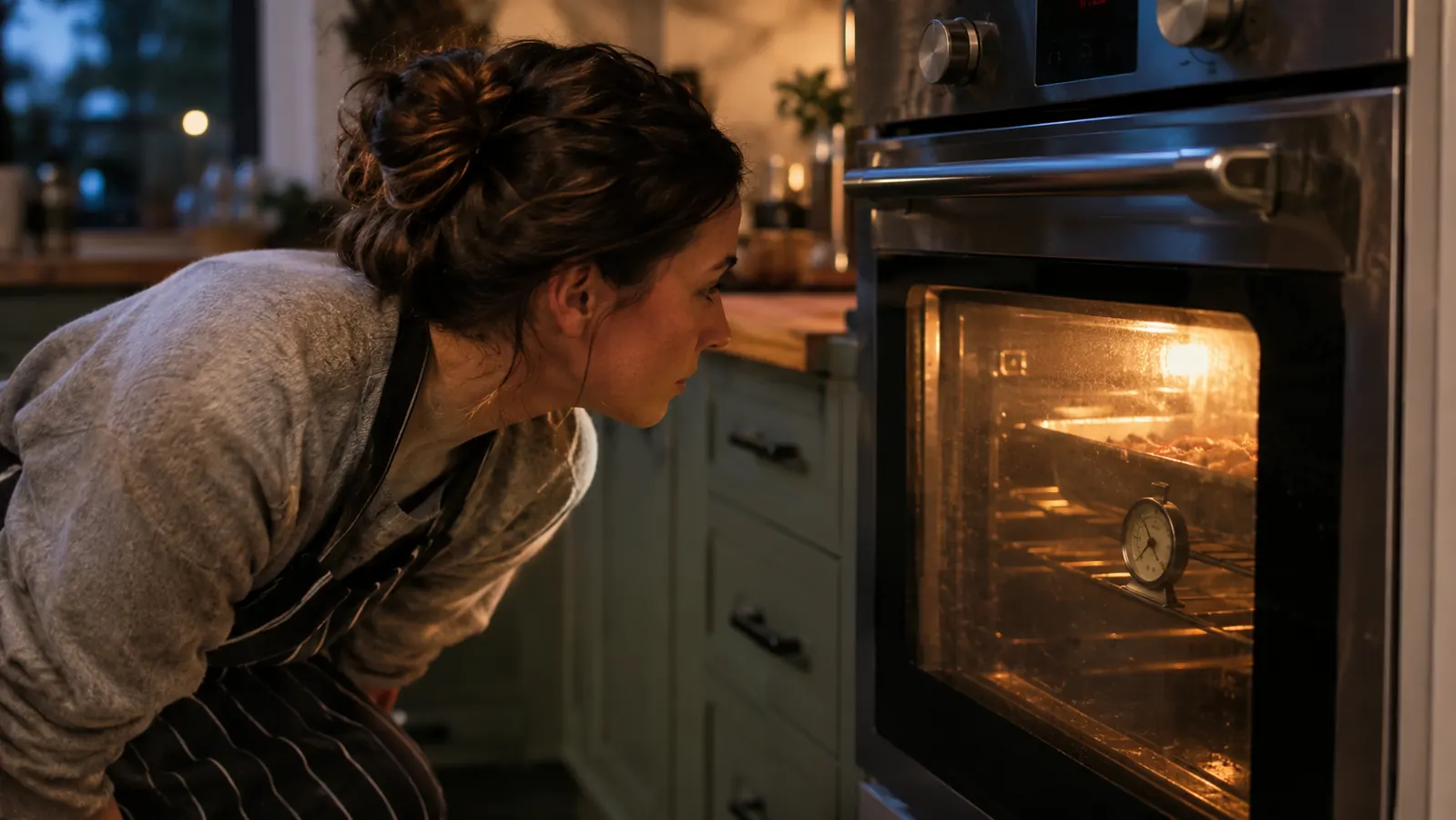
The second downside is that reading the dial through the oven door is harder than it sounds. The dial is large, but the glass is tinted, and the kitchen light reflects off it. I often have to turn on the oven light and crouch down to see the needle clearly. If I am in a hurry, I open the door and look. That lets heat out, which is exactly what you are trying to avoid.
The third downside is that it is one more thing to keep track of. It lives on the rack, so it is easy to forget it is there until you reach in for a hot pan and your hand brushes against a very hot piece of metal. It has never burned me badly, but it has startled me more than once. You learn to look before you reach.
And one more honest note: the product listing says it is battery powered, which is odd for an analog thermometer. Mine has never needed a battery. I have used it for over a year, and it works exactly as it did on day one. I cannot explain the listing, but I also cannot complain about the result.
One more thing: because it sits on the rack, it is always in the way just a little. I have learned to work around it, but it is worth knowing before you buy.
How It Compares to the Oven Dial
If you are trying to decide between this thermometer and the dial on your oven, the short answer is that the oven dial tells you what the oven is trying to do, and the Taylor tells you what the oven is actually doing. Those are not the same thing. This site has a longer comparison of the Taylor and the oven dial, but the short version is this: buy the thermometer.
The oven dial is convenient because it is right there on the front of the stove. But it is measuring the setting, not the heat. The Taylor measures the air inside the oven, which is what your food actually experiences. For the cost of a couple of loaves of bread, you get information that changes how every recipe turns out.
I have also used a digital probe thermometer, and I reach for the Taylor more often because it is already there. The digital probe gives you a precise number and a timer, but it takes up counter space and needs to be put away. The Taylor lives on the rack, so it is always ready. That sounds lazy, but in a busy kitchen, lazy often wins.
I should also say that the Taylor is not the only thermometer I have tried. I have used a cheap dial thermometer that came with a turkey roasting pan, and it was nowhere near as easy to read. The Taylor is bigger, clearer, and easier to trust. That is the whole point. A thermometer only helps if you actually look at it.
One more comparison: the dial on my oven looks more precise than the Taylor, with smaller marks between the numbers. But the oven dial is not measuring anything. It is just a knob. I would rather have a slightly coarser reading of the truth than a precise reading of a guess.
What I Liked
- Large dial with marked optimal cooking zones makes it easy to see if you are in the right range.
- Reads from 100 to 600 degrees Fahrenheit, covering everything from slow roasting to high-heat baking.
- Stainless steel build has held up to daily use for over a year.
- Light and small enough to move around the oven to find hot spots.
- Simple analog design that keeps working without any fuss.
Where It Falls Short
- 50 degree markings mean you are often guessing between lines.
- Hard to read through the oven door glass, especially in bright kitchen light.
- Gets very hot and easy to forget on the rack.
- Not dishwasher safe, so it needs hand wiping.
Who This Is For
This thermometer is for anyone who bakes in an ordinary oven and suspects the oven is not telling the truth. If your cakes are dry on the edges and raw in the middle, if your cookies spread more than the recipe says they should, or if you just want to know what is actually happening inside the oven, this is the tool. It is also for people who want a simple, no-fuss tool that does not need charging, pairing, or an app.
It is also for people who bake in a rental kitchen and do not want to argue with a landlord about the oven. A thermometer will not fix a bad oven, but it will tell you exactly how bad it is, and that knowledge lets you work around it. I have friends who rent, and I have told every one of them to buy one.
If you are shopping for a gift for someone who bakes, this is a good one. It is small, useful, and easy to wrap. The person will use it every week and think of you every time they check the oven.
Who Should Skip It
Skip it if you want a digital readout with exact numbers, because this is an analog dial and it will not give you that. Skip it if you are unwilling to adjust your baking based on what it tells you, because the information is only useful if you act on it. And skip it if you are hoping a thermometer will fix an oven that is wildly uneven. It will show you the problem, but it will not solve it. You still have to rotate pans and move things around.
I would also say skip it if you are the kind of baker who follows a recipe exactly and never changes anything. The Taylor will show you that your oven is not what the recipe assumes, and that is a door you cannot unopen. Some people would rather not know. If that is you, save the money.
The thermometer that earned a permanent spot on my oven rack
If you bake in a standard oven and you are tired of guessing, this is the tool. It is simple, it works, and it has been on my rack for over a year.
Amazon Check Today's Price on Amazon →