
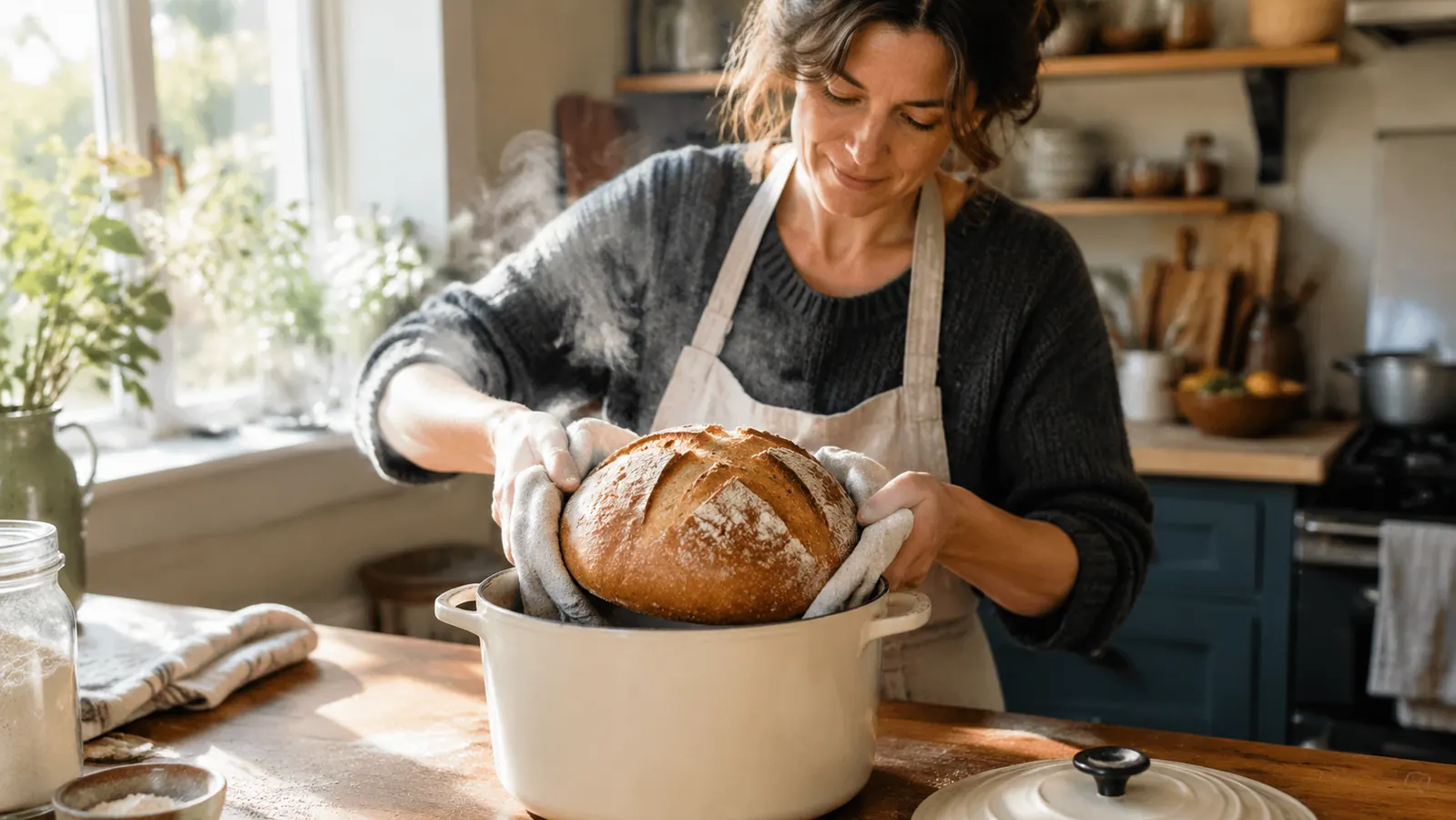
The first loaf I baked in this Overmont Dutch oven came out with a crust that cracked like frozen snow when I knocked on it. That was months ago, and it is still the thing I reach for every Saturday morning. I am Marisa Brandvold, a home baker who has made bread every week for about fifteen years, working in a standard electric oven in a two-story house outside Madison, Wisconsin. The Overmont Enameled Cast Iron Dutch Oven, 5.5 quarts, has earned a permanent spot on my pantry shelf, and after months of regular use I have a real opinion about it, not a first-impression one.
Before this pot, I baked my loaves on a baking sheet with a pan of water underneath, and the bread was fine. Fine is a sad word for something you spend three days making. The pot changed my Saturday routine in one bake: a taller rise, a louder crust, and an even crumb I had only ever seen in bakery photos. I have since used it for stews, braised chicken, and at least four school bake sales, so this review comes from everyday use, not a single perfect afternoon.
The Quick Verdict
A 5.5 quart enameled cast iron Dutch oven that makes better bread than anything else I own, cleans up without drama, and has held up to months of weekly use. The weight and the hand-wash rule are the real tradeoffs.
Amazon Check Today's Price →The one pot that fixed my sandwich bread
If your loaves come out pale and flat on a baking sheet, an enameled cast iron Dutch oven changes the result in a single bake. I have used this Overmont weekly for months and would buy it again tomorrow. Check today's price on Amazon to see where it lands.
Amazon Check Today's Price on Amazon →How I've Used It
Most Saturdays, I mix a sourdough loaf in the morning and bake it in the early afternoon. The pot goes into my standard electric oven empty, the oven heats to 450 degrees, and I let the pot sit in there for a full 45 minutes before the dough goes in. Then the loaf bakes with the lid on for the first half hour and with the lid off for the rest. I use the same method for no-knead bread on weekdays, and it works just as well with a shorter rise. That is the whole method, and it has not failed me once.
The 5.5 quart size is the reason this works for my kitchen. It fits a standard round loaf with room to spare, and at 13.2 by 13.2 by 7.1 inches, it sits comfortably in my oven with space around it for air to move. I have also used it for a 3 pound chuck roast, a pot of chili for the school fundraiser, and braised chicken thighs for a weeknight dinner that Nora still asks about. It is not a specialty bread tool. It is the pot I reach for when I need to feed the family.
Two details from the box have stayed in rotation. The silicone mat lives on my counter under the pot when it comes out of the oven, because a 500 degree pot will mark a wooden surface. The pot holders are thicker than the ones I already owned, and I use them every single time. The recipe book is not filler. The braised chicken recipe in it is the one Nora still asks about.
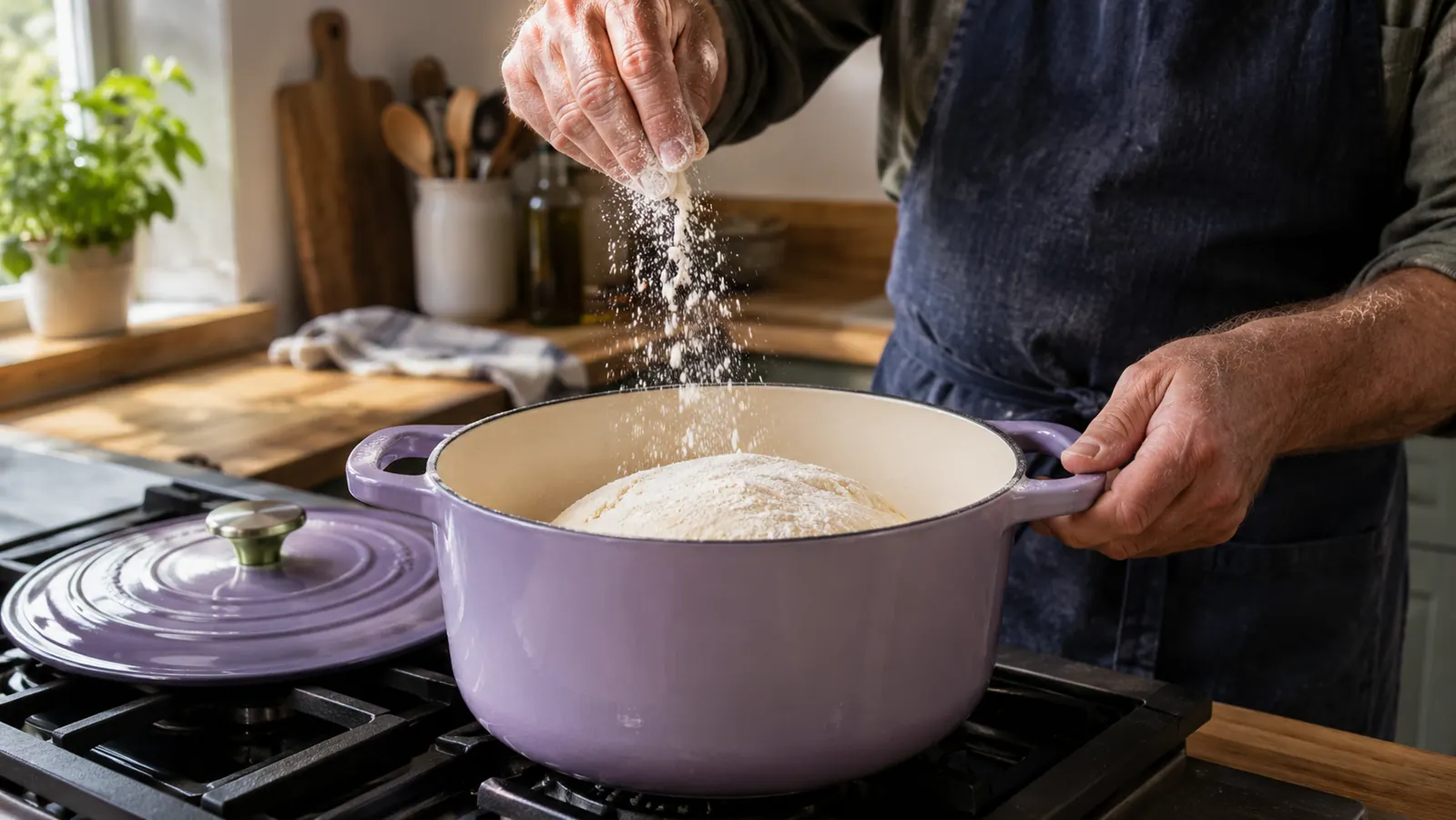
What the 5.5 Quart Size Actually Means
The listing says this size is ideal for families of 3 to 5 people, and that matches my house exactly. Tom, Nora, Ben, and I are four, and a full pot of soup or stew feeds us for dinner with leftovers for Ben's lunch the next day. For bread, the size is generous without being wasteful. A 1 kilogram boule fits with room to expand, which means the dough does not climb the walls and stick to the lid.
The dimensions matter more than people expect. At 13.2 inches wide and 7.1 inches tall, this pot fits in a standard home oven with clearance on every side. My oven is nothing special, just the electric one that came with the house, and I have never had to angle the pot or rearrange the rack to make it fit. The round shape also means the pot sits evenly on my stovetop burners, which matters when I use it for stovetop braises.
If you cook for one or two, this pot will feel large, and smaller sizes exist for a reason. But for a family that actually eats, 5.5 quarts is the sweet spot. It is big enough to matter and small enough to heat up quickly and store on a normal shelf.
Heat Retention and the Crust Question
The reason bread bakes better in a Dutch oven is not magic. The cast iron body holds heat, and the heavy lid traps the steam that escapes from the dough as it bakes. That steam keeps the outside of the loaf soft while the inside expands, and then when you take the lid off, the remaining heat crisps the crust. The Overmont does this job exactly the way cast iron should, with a 500 degree temperature rating that covers every temperature my home oven can reach.
The feature list says exceptional heat retention, and that is the one marketing phrase I will defend. I have preheated this pot empty for 45 minutes and dropped in cold dough, and the oven temperature barely dips. The result is a loaf that rises tall in the first twenty minutes instead of spreading flat. My baking sheet loaves never did that.
I should be honest that the cast iron body is heavy. Heavier than any nonstick pot I own, and I lift it with both hands every time. When it is full of stew, I set it on the counter and do not move it until it is empty. That is the tradeoff for the heat retention, and it is one I have made peace with.
The Enameled Finish in Real Life
The enameled finish is the reason I chose this pot over a plain cast iron one. I have owned bare cast iron, and I respect it, but I did not want to manage seasoning on a pot I use for bread and braised chicken. The enameled surface needs no seasoning, and I have made a pot of marinara in it and left it in the fridge overnight without a second thought. That is something I would not do with my bare cast iron skillet.
The care instructions say hand wash only, oven safe, stove safe, and wipe with a dry cloth. I have followed the hand-wash rule for months, and the finish still looks the way it did the day it arrived. Burnt bits from a too-hot sear soak off in warm water, and a soft sponge handles the rest. I keep the dry cloth habit because enameled cast iron is the kind of thing you protect.
The lid is enameled cast iron too, which means it is just as heavy as the pot and just as easy to clean. The one thing I watch for is knocking the rim against the sink when I wash it. Enamel can chip if you treat it carelessly, and a chip is the one thing you cannot fix. I have not chipped mine, but I am careful, and I think you should be too.
What Comes in the Box
The box includes three things beyond the pot itself: a recipe book, a silicone mat, and two pot holders. I have bought plenty of kitchen tools where the extras were clearly there to make the box feel fuller. These are not that. The silicone mat is the right size to protect a counter or table from a hot pot, and I use it every bake. The mat is thin enough to store flat against the side of the pot, so it does not add clutter to the cabinet. The pot holders are thick enough to actually protect your hands, which matters when you are moving a 450 degree pot full of bread.
The recipe book has been a surprise. It includes the braised chicken recipe that has become a regular dinner at our house, and the bread method in it matches the one I already used. It is not a glossy shelf ornament. It is a working cookbook, and I keep it on the shelf with my other baking books.
The 1 year manufacturer warranty is worth knowing about. It is not the longest warranty in the category, and if a longer one matters to you, that is a fair reason to compare other brands. For me, the pot has been so consistent that the warranty length has not come up, but I would rather tell you about it than let you discover it later.
Tradeoffs and Honest Notes
No honest review ends with everything perfect, so here are the things I would want to know before buying. The pot is heavy, as I said, and the hand-wash rule is real. If you are used to throwing everything in the dishwasher, this pot will ask you to change that habit. The enamel is durable but not indestructible, and the rim is the spot to protect. None of these are reasons to skip the pot. They are reasons to buy it with your eyes open.
The 5.5 quart size is right for my family of four, but it is a lot of pot for one or two people. The 500 degree temperature rating covers every home oven I have ever used, but if you own a commercial-grade oven that goes higher, you will be limited by the pot, not by your oven. Those are small notes, but they are honest ones.
One more thing: the pot does not need to be a bread-only tool, and it should not be. The same heat retention that makes a good crust makes a good braise, and the stove-safe base means you can sear on the burner and move straight to the oven. The pot also goes to the table for serving, which is where the enameled finish earns its keep. That flexibility is the reason this pot has stayed on my counter instead of living in the back of a cabinet.
What I Liked
- Exceptional heat retention from the cast iron body, rated to 500 degrees
- 5.5 quart size fits family meals for 3 to 5 and standard round loaves
- Oven safe and stove safe, so one pot moves from burner to oven
- Enameled finish needs no seasoning and cleans up with a sponge
- Includes a useful recipe book, silicone mat, and two pot holders
- Round shape fits a standard home oven with clearance on every side
Where It Falls Short
- Heavy to lift, especially when full
- Hand wash only, no dishwasher
- Enamel rim can chip if knocked carelessly
- 1 year manufacturer warranty is shorter than some competitors
My Saturday loaf went from pale and flat to tall and crackly on the first bake in this pot, and months later it still comes out the same way every time.
Who This Is For
This pot is for the baker who is tired of pale loaves and ready to fix the problem with equipment instead of adding another variable to the recipe. It is for the family cook who wants one pot that does bread, stew, braised chicken, and the occasional pot of beans. It is for people who would rather buy one good piece and take care of it than replace a cheap one every two years.
It is also for people who cook for three to five. The 5.5 quart size is genuinely useful at that scale, and the included mat and pot holders mean you do not have to buy anything else to start using it the day it arrives. If you are a home baker with a standard oven and a real appetite for crusty bread, this pot will earn its shelf space.
Who Should Skip It
If you bake bread twice a year and the rest of the time you reach for a sheet pan, you do not need a 5.5 quart Dutch oven taking up cabinet space. If you are a household of one or two, a smaller size would serve you better. And if the dishwasher is a hard requirement, the hand-wash rule here is not going to change your mind, so save yourself the argument.
If you need to cook for a crowd, this size will feel small, and you would be better served by a larger pot or two smaller ones. And if you are the kind of cook who does not want to think about protecting a finish, a bare cast iron pot or a stainless steel one might be a better match. This pot asks for a little care, and in return it gives you years of good bread.
The pot I would buy again tomorrow
After months of weekly bakes, the Overmont Dutch oven is the piece I reach for without thinking. If you are ready to fix your crust and feed your family from one pot, check today's price on Amazon.
Amazon Check Today's Price on Amazon →