
For the last year and a half, my parchment paper drawer has been slowly losing its mind. I buy the big roll, use it for three batches of cookies, and then the roll disappears under a bag of flour, or the box collapses, or I reach for it at 9 p.m. and find one sad sheet left. So when I finally bought the OXO silicone baking mat, I expected a neat little kitchen gadget. What I did not expect was to stop buying parchment almost entirely. I also did not expect to learn a few things about silicone that no product page ever mentions.
This is the honest part. I have baked every week for about fifteen years, mostly from my grandmother's recipes, and I am not a person who collects single-purpose tools. My kitchen has one standard electric oven and one modest stretch of counter, and everything on my pantry shelf has to earn its spot. The OXO mat earned its spot, but not in the way the product listing led me to believe. It is not a magic sheet that makes every bake turn out perfect. It is a very good reusable non-stick surface with real limits, and knowing those limits is the difference between loving it and letting it gather dust.
The Quick Verdict
A genuinely useful reusable baking surface that replaced most of my parchment, as long as you accept softer cookie bottoms and a 450°F ceiling.
Amazon Check Today's Price →The reusable sheet that quietly retired my parchment roll
I bought this for one bake sale and it has stayed on my shelf ever since. If you bake more than once a week, it is worth a look. Check today's price on Amazon and read the recent reviews before you decide.
Amazon Check Today's Price on Amazon →How I've Used It
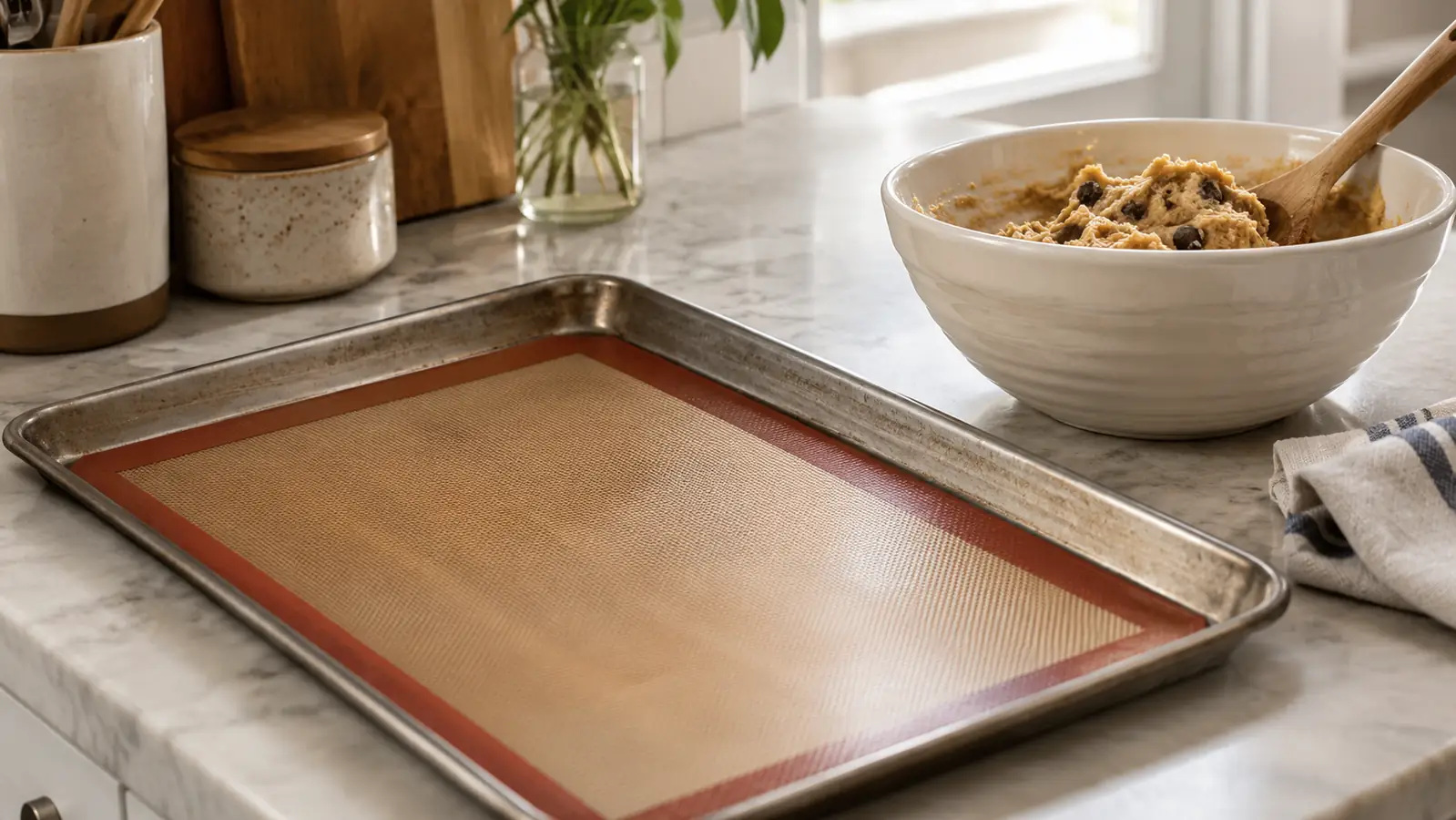
I bought the mat for one reason: the school bake sale. Every spring I make four dozen chocolate chip cookies, and every spring I run out of parchment halfway through and end up washing the same pan three times. The OXO mat is 16.5 by 11.5 inches, which covers most of a half-sheet pan, and it is made of food-safe silicone with a fiberglass core that keeps it from collapsing into a puddle. I slid it onto my pan, dropped six cookies on it, and baked them at the temperature my recipe has used for years.
The cookies came out fine. That is the boring truth. They did not stick, they did not spread oddly, and they slid right off with a spatula. I have since used the mat for roasted vegetables, a sheet-pan dinner, cinnamon rolls, and at least ten more rounds of cookies. It has been through the dishwasher more times than I can count, and it still lies flat and looks the same as the day it arrived.
But here is what I wish someone had told me before I bought it. Silicone does not behave like parchment. It does not absorb grease, it does not crisp the way paper does, and it has a temperature ceiling. The listing says oven safe up to 450 degrees, which sounds generous until you remember that some bread recipes and most pizzas want more. I have never hit that ceiling, but I have also never roasted anything above 425, so I am the right customer for it.
One thing I did not expect: the mat works just as well for roasting as for baking. I use it under chicken thighs, under a sheet of frozen fries, and under a tray of carrots and parsnips. The vegetables brown on top, the pan stays clean, and the mat goes in the dishwasher with everything else. For weeknight cooking, that alone is worth the shelf space.

What It Actually Replaces (and What It Doesn't)
The honest answer is that the OXO mat replaced about eighty percent of my parchment use. Anything that fits on a half-sheet pan and bakes at or below 450 degrees is fair game. Cookies, sheet cakes, roasted vegetables, chicken thighs, frozen fries, reheat night. For those jobs the mat is better than parchment in one clear way: it stays put. Parchment curls at the corners, slides under the spatula, and tears when you lift a heavy tray. The mat has a little grip to it, so it does not wander.
The twenty percent it does not replace is the part that surprised me. When I make sugar cookies that need a crisp, golden bottom, the mat works against me. Silicone insulates. The bottom of the cookie bakes more slowly than it would on a bare pan or on parchment, so I get a softer, paler underside. For chewy chocolate chip cookies, that is actually lovely. For a thin, crisp biscuit, it is the wrong tool.
It also does not cover the whole pan. The mat is 16.5 by 11.5 inches, and a standard half-sheet pan is 18 by 13. That leaves a margin around the edges, which matters if you are roasting something juicy. A cherry pie that bubbles over will still land on the pan and make a mess. I learned that the hard way, and now I only use the mat for things that do not boil over.
The Part Nobody Mentions: It Changes How Things Brown
This is the tradeoff that no review I read before buying mentioned. Silicone is an insulator, so it slows down browning on whatever touches it. For the bottom of a cookie, that means paler and softer. For the bottom of a sheet-pan chicken, that means the skin on top crisps while the underside stays tender and a little steamy. If you like a deeply browned bottom crust on everything you bake, this mat will frustrate you.
I adjusted by changing what I use it for. The mat is now my default for anything where I want a soft, even bake: cookies, cinnamon rolls, sheet cakes, and anything I would normally put on a silicone baking sheet. For things that need a hard, crackly bottom, I go back to a bare pan or a sheet of parchment. That division of labor has worked well for over a year, and it is the single most useful thing I can tell you about this product.
The other adjustment is time. Because the mat insulates, some recipes need an extra minute or two in the oven. I have not found a recipe that needed more than three extra minutes, but I have also stopped assuming my usual bake time will be exactly right. I check things a couple of minutes early, especially the first time I bake something new on the mat.
The first batch of cookies came out paler on the bottom, and that one detail taught me more about this mat than any product page.
Cleanup, Storage, and the Small Annoyances
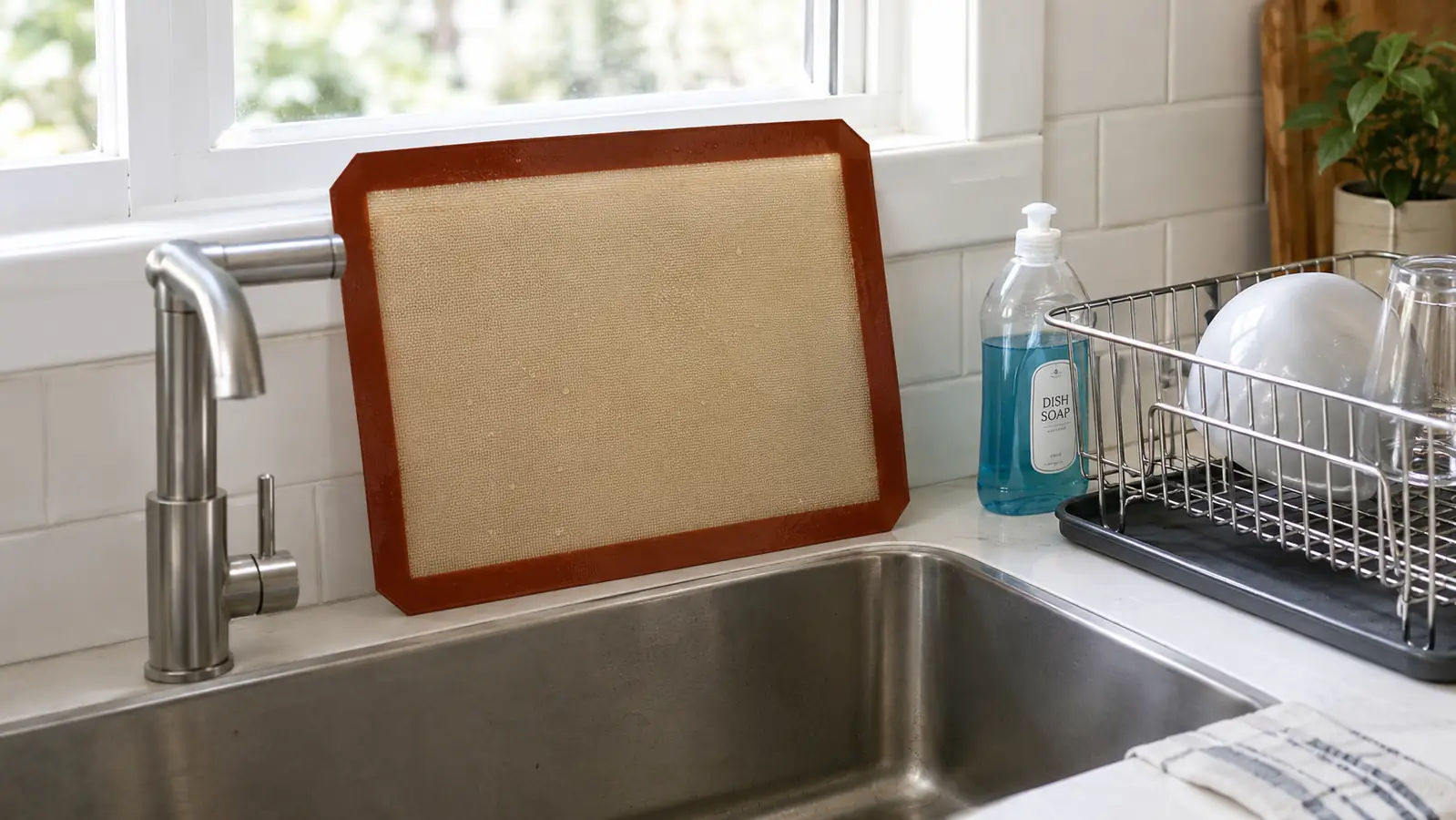
The good news first: the mat is dishwasher safe, and it cleans up beautifully. Most of the time I rinse it under the tap, give it a quick wipe with a sponge, and lean it against the back of the sink to dry. Grease does not bake onto it the way it bakes onto a metal pan. Even after roasted chicken, the residue slides off with warm water and a drop of soap. The whole thing weighs only 5.6 ounces, so it is easy to handle one-handed.
The small annoyances are real, though. The mat is floppy. It has a fiberglass core that gives it structure, but it is still a flexible sheet of silicone, so it folds and curls when you try to carry it to the oven with something heavy on it. I have learned to slide the pan underneath the mat before I load it, or to put the mat on the pan first and fill it there. The other annoyance is storage. It is too big for my utensil drawer and too floppy to stand on edge, so it lives flat between two sheet pans on my pantry shelf. That works fine, but it is a thing nobody tells you.
One more honest note. The listing calls the material 'chemical free,' which is a strange claim, because everything is made of chemicals. I read that as marketing language for food-safe silicone, and the listing does say the mat is food safe. If you want to know exactly what is in the thing touching your food, the product page tells you it is silicone with a fiberglass core, and that is the extent of what I can tell you from the label.
I have also left the mat on the counter overnight more than once, which is not something I would do with parchment. It does not absorb smells, it does not stain from tomato sauce, and it does not need to be babied. A quick rinse in the morning and it is ready to go again.
The First Week vs. a Year Later
In the first week I almost sent the mat back. My cookies came out with paler bottoms, I could not figure out why, and I blamed the mat. Then I baked the same dough on a bare pan and on the mat side by side. The bare pan gave me the crisp, golden bottom I remembered. The mat gave me a softer, paler one. That was the moment I understood the mat was not broken. It was insulating, and I needed to work with that instead of against it.
A year later, the mat is one of the most-used items on my shelf. It has been through hundreds of dishwasher cycles, it has held up to spatulas and metal tongs, and it still lies flat. I reach for it more often than my rolling pin, which says a lot for a baker who grew up on her grandmother's pie crust. The only thing that changed is my expectations. I no longer ask the mat to crisp things. I ask it to make cleanup easy and to keep things from sticking, and it does both without fail.
The Bottom Line
If I had to sum up the OXO silicone baking mat in one sentence, it is this: it is the best reusable sheet-pan liner I have found, and it is not the right tool for every bake. I use it weekly, I would buy it again, and I would give it as a gift to a friend who bakes cookies more than once a month. But I would also tell that friend exactly what I told you here, because the mat rewards bakers who understand what it can and cannot do.
The mat earns its place the way most good tools do: by being excellent at a specific set of jobs and honest about the rest. It will not replace your parchment drawer entirely, it will not crisp the bottom of a pie, and it will not survive a 500-degree oven. What it will do is sit flat on your half-sheet pan, release every cookie you put on it, and wash up in under a minute, for years. That is a fair trade, and it is why mine has a permanent home on my pantry shelf.
If you are still deciding, here is the short version. Buy the OXO mat if you bake cookies or sheet-pan dinners at least once a week and you want to stop restocking parchment. Skip it if you are a pastry purist who needs a crisp bottom on everything. Either way, you now know the one thing the product page leaves out: silicone insulates, and that changes your bake times and your browning.
What I Liked
- Reusable and dishwasher safe, so it cuts way down on parchment waste
- Stays put on the pan better than parchment ever did
- Food-safe silicone with a fiberglass core, oven safe to 450 degrees
- Easy cleanup even after greasy roasts
- A good fit for half-sheet pan bakes like cookies and sheet cakes
Where It Falls Short
- Silicone insulates, so cookie and crust bottoms come out paler and softer
- Leaves a margin on a standard half-sheet pan, so messy bakes can still spill onto the pan
- Floppy to carry when loaded, so it is best filled in place on the pan
- Storage is awkward; it needs to lie flat between pans
- Not for high-heat baking above 450 degrees or recipes that need a crisp bottom
Who This Is For
This mat is for the home baker who makes cookies, sheet cakes, roasted vegetables, and sheet-pan dinners at or under 450 degrees, and who is tired of buying parchment rolls that vanish at the worst moment. It is also for the person who hates scrubbing baked-on grease, because the mat genuinely makes cleanup faster. And it is for the baker who wants one reliable reusable surface that lives on the shelf and gets used weekly, not a drawer full of single-purpose gadgets.
If that sounds like you, the OXO mat will probably earn its cabinet space within the first month. If you are on the fence, the question to ask yourself is not whether it works, because it does. The question is whether you bake the kinds of things that play to its strengths: soft, even bakes on sheet pans, with easy cleanup and no parchment to restock.
Who Should Skip It
If your baking is all about crisp, deeply browned bottoms, this mat will fight you. Skip it if you regularly bake above 450 degrees, because the ceiling is real and I would not push it. Skip it if you mostly bake in loaf pans, on round pizza stones, or in anything that is not a half-sheet pan, because the mat is rectangular and sized for sheet pans.
And skip it if you are the kind of cook who will not adjust bake times, because silicone does change how things brown. For those bakers, a roll of parchment is the more honest tool for the job. There is no shame in that. Parchment is disposable and dependable, and it does not ask you to change anything about how you bake. The mat is a different tool for a different set of jobs, and the sooner you know which set you are in, the happier you will be with either choice.
The reusable mat that earned permanent shelf space in my kitchen
If this sounds like your kitchen, the OXO silicone baking mat is worth a close look. Check today's price on Amazon and read the recent reviews before you decide.
Amazon Check Today's Price on Amazon →