
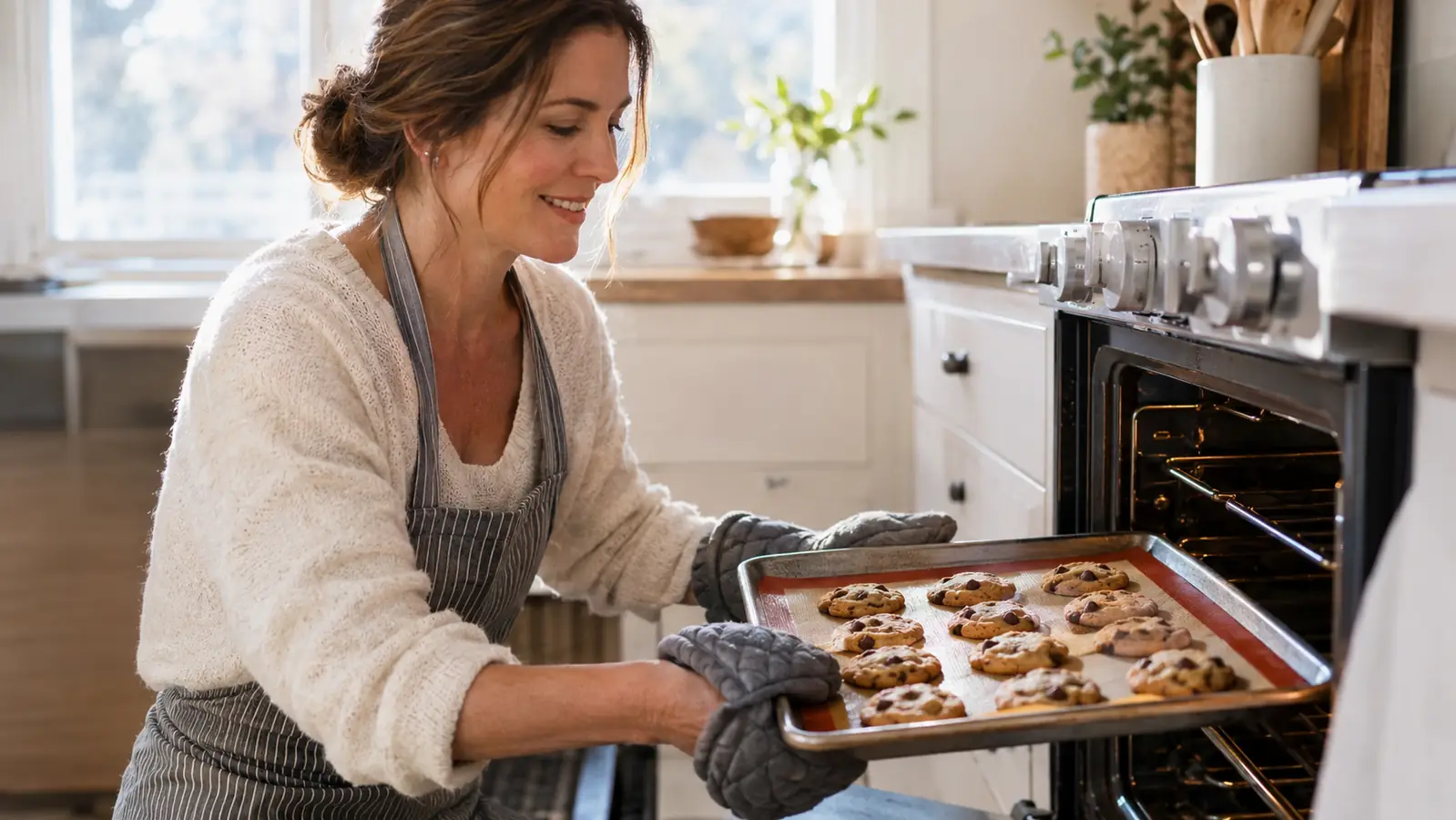
Every other week I pull a half-sheet pan out of my oven with something on it, and for years the routine was the same. Tear off a sheet of parchment, line the pan, bake, then toss the parchment when the pan cooled. It worked. It also meant I bought parchment in bulk, ran out at the worst moments, and watched a lot of paper go into the compost. When I finally bought the OXO Good Grips Silicone Baking Mat, it was less a decision than a surrender. I was tired of the routine, tired of the curled corners, and tired of the roll disappearing right before Thanksgiving baking week.
I have now baked hundreds of batches on this mat. Cookies, sheet cakes, roasted vegetables, cinnamon rolls, and bread dough rolled out right on the surface. It has been through my one standard electric oven more times than I can count, and it still does the one thing I need it to do: let the bake come off the pan without a fight.
The Quick Verdict
The reusable non-stick surface that replaced my parchment roll for most of my baking. It releases cleanly, washes in the dishwasher, and has held its shape through hundreds of batches.
Amazon Check Today's Price →The mat I reach for before the parchment roll
If you bake more than once a week, this is the reusable surface that earns its cabinet space. It sits flat on a half-sheet pan, takes the heat up to 450°F, and cleans up in the dishwasher.
Amazon Check Today's Price on Amazon →How I've Used It
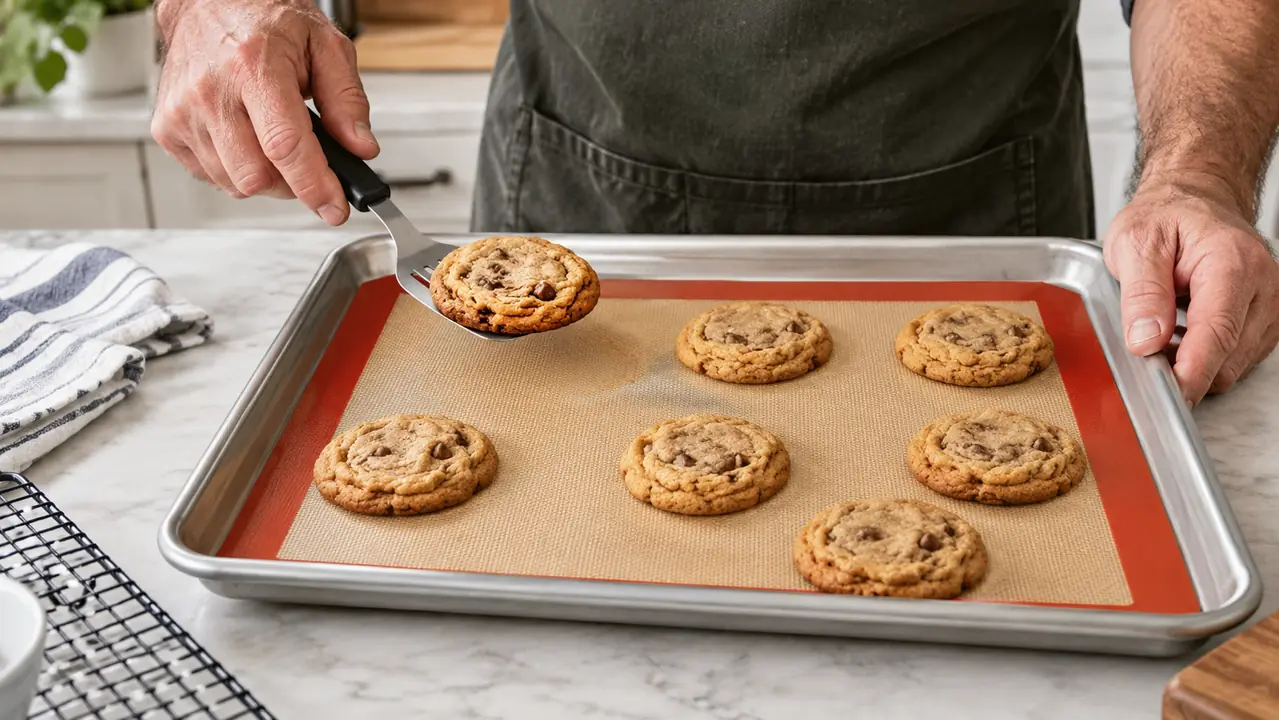
Most weeks this mat is out of the drawer at least twice. I use it for the obvious things: chocolate chip cookies, oatmeal raisin cookies, and the sugar cookies my daughter Nora decorates for the school bake sale. It also does the less obvious jobs. I roast vegetables on it because it catches the drips from olive oil and lemon juice without turning into a baked-on mess. I roll out bread dough on it, flour the surface lightly, and transfer the whole thing to the pan. The fiberglass and silicone construction keeps it from flopping around, so it behaves like a real work surface instead of a limp sheet.
The size is the part I did not expect to matter as much as it does. At 11.5 by 16.5 inches it fits a standard half-sheet pan edge to edge, which means no fiddling with the corners and no dough sneaking past the edge. It weighs almost nothing, 5.6 ounces, so it is easy to lift in and out of the oven even with one hand while the other holds the pan.
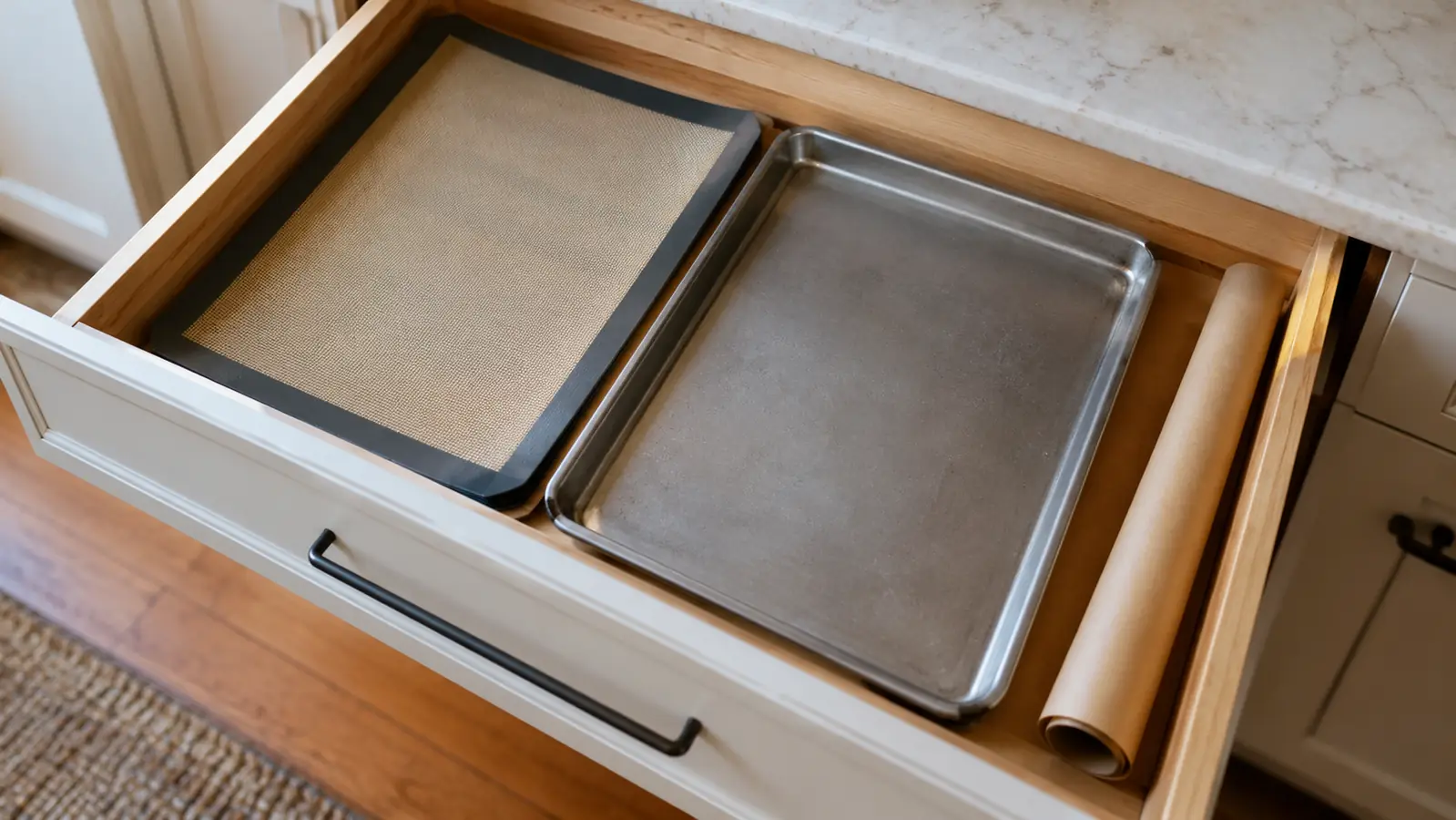
Cleanup is where it wins the week. It is dishwasher safe, and I put it in the dishwasher. When I am feeling lazy it rinses clean under hot water in about ten seconds because the surface resists grease and residue. I have never had to scrub it. That is not something I can say about my sheet pans, and it is the reason the mat has stayed in the drawer instead of migrating to the back of the pantry. Storage is just as simple. It is flexible enough to roll up for a shelf, or it can lie flat in a drawer. Mine lives flat in the drawer under the counter where I keep my half-sheet pans, so it is always right where I need it. At 5.6 ounces it adds almost no weight to the drawer, and it takes up less space than the box of parchment it replaced.
What It Replaced in My Kitchen
Before the OXO mat, I was a parchment person. I still am, partly. Parchment is cheap, it handles heat higher than 450°F, and you can cut on it without worrying. But for everyday baking, the mat does the same job without the roll running out. I used to keep three rolls of parchment in the pantry because I was always caught short. Now one roll lasts me months, because the mat is what I reach for first.
The honest comparison comes down to this. Parchment is a disposable tool, and the mat is a reusable one. If you bake once a month, parchment is probably fine and the mat is an extra thing to wash. If you bake every week, the mat pays for itself in what you stop buying and in the quiet pleasure of not having to tear off a sheet, smooth it down, and watch the corners curl up while the oven preheats. I did not realize how much that little ritual annoyed me until it was gone.
I will also say the mat has changed how I think about the bake sale. When I make six dozen cookies for the school table, I bake them in batches and the mat goes back in the drawer between pans. It is ready again in the time it takes the oven to recover. That consistency is the whole point of a good baking tool: the second batch comes out exactly like the first. With parchment, every new sheet was a small gamble on how it would lie and whether it would slide.
How It Holds Up After Hundreds of Batches
I should be clear about what I mean by hundreds of batches. I bake every week, sometimes twice. Between my family, my coworkers, birthdays, and the school bake sale, the oven is on more days than it is off. The mat has seen all of it, from a single tray of cookies on a Tuesday night to six dozen sugar cookies in one afternoon. That range matters, because a tool that only works for one kind of baking is a tool I will stop reaching for.
Sixteen months in, the OXO mat still lies flat. That was my biggest worry when I bought it, because I had tried cheaper silicone mats before and they developed a permanent curl at the edges within a few uses. This one has not. It comes out of the dishwasher flat, it stores flat in the drawer, and it sits flat on the pan. The fiberglass in the construction does what it is supposed to do, giving the mat enough structure to stay put without making it stiff.
The surface still releases cleanly. I do not oil it, and I do not grease it. Cookies come off with a spatula and no torn edges. A tray of roasted vegetables slides off onto a serving plate without leaving half the squash behind. There is a light haze of use on the surface if I look closely, the same sort of seasoning you get on a good baking pan, but it has never affected how anything releases. If anything, the release has gotten more reliable with use.
The only wear I have noticed is on the very edges, where the mat rubs against the rim of the pan, and even that is cosmetic. It has not peeled, cracked, or warped. I treat it the way I treat my good pans: I do not cut on it with a sharp knife, and I do not fold it into a tight crease. Given that, I expect this one to outlast my current roll of parchment several times over. I cannot say that about most things in my kitchen.
The 450°F Limit and What It Means
Here is the tradeoff I want to be straight about. The OXO mat is oven safe up to 450°F, and that covers almost everything I bake in my standard electric oven. Cookies, cakes, muffins, roasted vegetables, most breads. But some things want more heat. My pizza stone routine runs at 500°F, and a few of my heartier bread recipes ask for a hotter oven than this mat can take. For those, I use parchment or a bare pan. I do not push the mat past its limit, because the limit is printed on the box for a reason.
In practice, the limit has cost me almost nothing. Most of my baking lives between 350°F and 425°F, and the mat handles all of it. Knowing the exact number has actually made me a better baker, because I check the oven temperature for each recipe instead of assuming. The mat is a tool with clear boundaries, and I would rather have that than a vague promise of very high heat. The boundary is also why I trust it: I know exactly what it can do.
What I Make With It Most
If I had to list the things this mat has touched in the last month, the list would be long. A batch of granola, because it catches the syrup without cementing it to the pan. A tray of roasted carrots for Sunday dinner. Two dozen lemon bars for a coworker's retirement. A loaf of sandwich bread that I shaped and proofed right on the mat before sliding the whole thing onto the pan. The mat does not care whether the job is sweet or savory, which is exactly what I want from a piece of equipment.
The lemon bars are the test I would give anyone. They are sticky, they are soft, and they are the kind of thing that welds itself to a pan. On the mat, they came off in perfect squares with the spatula doing almost no work. My husband Tom, who does not notice kitchen equipment, noticed that one. He asked what I had done differently, and I pointed at the mat. That is the highest praise a baking tool can get in this house.
The granola is the other regular. I spread it thin on the mat, and the syrup browns without gluing the oats to the pan. When it cools, I lift the whole sheet and break it into pieces over the bowl. That is a job I used to do on parchment with a spatula and a lot of patience, and the mat does it better.
What I'd Change if I Could
If I could change one thing, it would be the size range. The 11.5 by 16.5 inch mat fits a half-sheet pan perfectly, and that is the pan I use most. But I also own a quarter-sheet pan for smaller jobs, and the mat is too big for it. I end up using parchment for those little trays, or I just bake fewer things at once. It is a small complaint, and it has not made me reach for the mat any less, but it is the honest answer.
The other thing I have learned is to give the mat a few minutes on the counter after the pan comes out of the oven. It cools fast, but not instantly, and the release is cleanest when I am not rushing it. That is not a flaw in the mat. It is just the patience any good tool asks for, the same patience my grandmother's cookie sheets demanded. I mention it because the reviews that made me buy this mat did not, and I would rather you know.
What I Liked
- Replaces parchment for most of my baking; one roll now lasts me months
- Food-safe silicone surface releases cookies, vegetables, and dough without sticking
- Fiberglass and silicone construction keeps it flat on the pan
- Fits a standard half-sheet pan at 11.5 by 16.5 inches
- Oven safe to 450°F and dishwasher safe
- Resists grease and residue, so cleanup is a rinse or a rack
Where It Falls Short
- 450°F limit means very hot bread and pizza still need parchment or a bare pan
- It is a reusable tool, so you do have to wash it, unlike tossing parchment
- You should not cut on it with a sharp knife, so it is not a cutting board
Sixteen months and hundreds of batches in, the mat still lies flat, still releases every cookie without a torn edge, and I have bought one roll of parchment since.
Who This Is For
This mat is for the baker who uses the oven at least once a week and is tired of buying parchment in bulk. It is for the person who wants the second batch of cookies to come out exactly like the first, who does not want to scrub a sheet pan, and who is willing to wash one flexible mat in exchange for not running out of paper at the worst moment. If you bake for a family, for coworkers, or for the school bake sale like I do, it will earn its drawer space in the first month.
Who Should Skip It
Skip it if you bake rarely, because parchment is cheaper and there is nothing to wash. Skip it if most of your baking happens above 450°F, because this mat has a real limit and you will not be able to use it for your hottest loaves. And skip it if you want a surface you can cut on, because this is a baking mat, not a cutting board. Those are honest reasons to leave it on the shelf, and I would give you the same answer at my kitchen counter.
The mat that ended my parchment shortage
If you bake every week, this is the reusable non-stick surface that releases cleanly, washes in the dishwasher, and has held its shape through hundreds of batches in my one standard oven.
Amazon Check Today's Price on Amazon →