

If you bake once a month for the school bake sale, you do not need a 22-pound stand mixer living on your counter. If you bake every week, the way I do, the question stops being about what looks nice in a catalog and starts being about what actually gets used. I am Marisa, and I have been baking from my grandmother's recipe cards for about fifteen years in an ordinary kitchen outside Madison, Wisconsin. I have one standard oven, one stretch of laminate counter that fits a cutting board and a canister, and a pantry shelf that has held both a KitchenAid Classic and a good hand mixer at different times. The hand mixer lives in a drawer next to the measuring cups; the KitchenAid comes out when it is really needed. I bought the KitchenAid after a year of telling myself I did not need one, and I was wrong about that. This comparison is the honest version of how I would choose between them today.
The short answer: the KitchenAid Classic wins for anyone who mixes more than one batch of something at a time, or who bakes bread, or who has ever held a hand mixer over a pot of hot frosting and felt their arm start to complain. A hand mixer wins for small batches, quick jobs, and kitchens where counter space is the real boss. Everything below is the longer answer, including the parts where the hand mixer wins, because I think the honest answer for most home bakers is that you eventually want both. The question is which one you buy first.
| KitchenAid Classic | Hand Mixer | |
|---|---|---|
| Mixing power | 275-watt motor with 10 speeds, handles stiff dough and 8 dozen cookies in one batch | Enough for eggs, cream, and soft batters; struggles with stiff dough |
| Batch size | 4.5-quart stainless bowl mixes up to 8 dozen cookies at once | Best for one or two egg whites, a single cake batter, or a small bowl of frosting |
| Hands-free time | Tilt-head stand mixer runs on its own while you measure or grease a pan | You hold it the whole time, which matters for long whip jobs |
| Cabinet space | 14.1 inches deep, 8.7 inches wide, 13.9 inches tall and 22 pounds | Small enough for a drawer or a crowded shelf |
| Cleanup | One stainless bowl, one beater, one dough hook, one whip to wash | Two beaters and a small bowl, quick to rinse |
| Best for | Weekly bakers, bread dough, big batches, anyone who wants consistent results | Quick weekday jobs, small households, tiny kitchens |
Where the KitchenAid Classic Wins
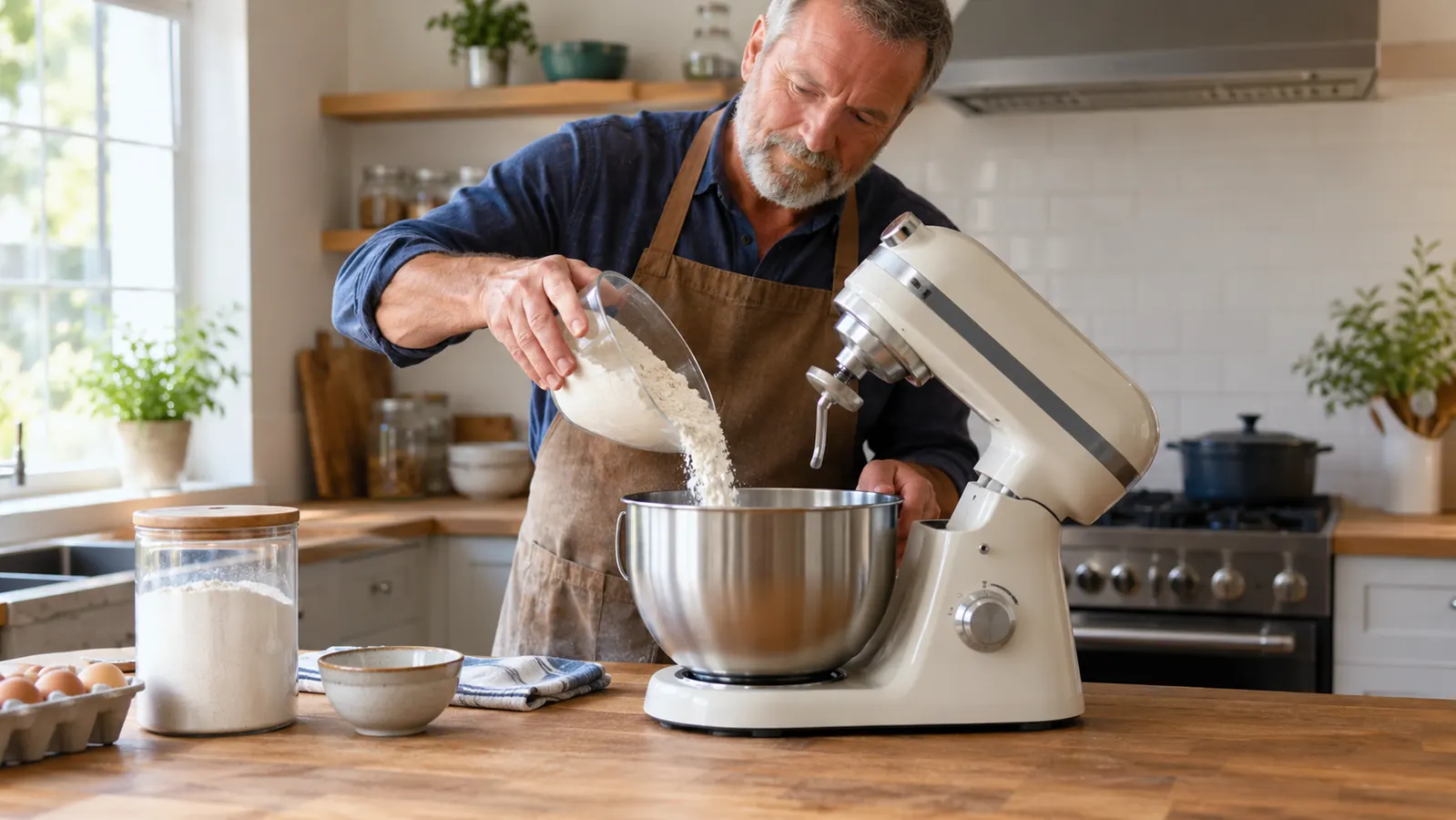
The first time I made a double batch of my grandmother's chocolate chip cookies in the KitchenAid Classic, the difference was not subtle. With a hand mixer I used to stop every minute or so to scrape the beaters, because the dough would climb the beaters and sulk at the bottom of the bowl. The KitchenAid has 59 touchpoints around the mixer bowl, which is a fancy way of saying the dough gets pushed back into the beater instead of just spinning in place. The flat beater reaches the bottom and the sides, and I can walk away to preheat the oven while it works. Last December, for the school bake sale, I made four batches of those cookies in one afternoon. The first batch went into the KitchenAid and I barely touched it. The second batch I tried to make with the hand mixer to test myself, and by the third batch I was back to the stand mixer, because my wrist was already complaining. The hand mixer did fine for the first dozen cookies, then the dough got stiff from the cold butter and it started to labor. I had to stop, scrape the beaters, and finish the last cup of flour by hand. I timed it once: the KitchenAid mixed that dough for four minutes while I lined two baking sheets and pulled the vanilla out of the cabinet. With the hand mixer, the same job would have taken closer to fifteen minutes with three stops to scrape. That afternoon settled the argument for me.
The 4.5-quart stainless bowl is the other reason I reach for it. The listing says it mixes up to 8 dozen cookies in a single batch, and I believe it, because I have made exactly that for the school bake sale and still had room in the bowl. The 10 speeds matter more than I expected. Stir speed folds in chocolate chips without pulverizing them, and speed 8 whips cream in the time it takes me to find the vanilla. On a Tuesday in February I made a brioche dough that started out so stiff I was sure I had mis-measured the flour. The KitchenAid worked through it at speed 2, and ten minutes later the dough was smooth and elastic. My old hand mixer would have stalled on that dough before the first cup of flour was in. The motor is 275 watts, which sounds modest on paper, but paired with the metal construction it handles a stiff yeast dough that would make a hand mixer labor and complain. I have also learned not to push it past what it is. The bowl is 4.5 quarts, and when a recipe says it handles 8 dozen cookies, that means the cookies, not the dough plus a second batch on top. I still divide a triple batch in two if I am making something with a lot of flour.
Where the Hand Mixer Wins
I am not going to pretend the hand mixer is the weaker tool in every way, because it is not. There are weeks when I use mine more than the KitchenAid. A single batch of brownies, two egg whites for a meringue, a small bowl of buttercream for a birthday cake, those are jobs where pulling out the 22-pound stand mixer feels like bringing a tractor to weed a window box. Last month I made a lemon meringue pie for Nora's birthday. I needed two egg whites whipped to soft peaks, and I used the hand mixer without even thinking about it. The whole job took four minutes, and the only clean-up was the two beaters and the bowl. If I had pulled out the KitchenAid for that, I would have washed the stainless bowl and the whip and then put the machine back on the pantry shelf afterward. The hand mixer is out of the drawer, into the bowl, and rinsed in the time it takes the KitchenAid to even settle into its spot on the counter. That is not a criticism of the stand mixer. It is just the truth about which tool fits which job. I have made that same lemon meringue pie three times since, and I have never once wished the stand mixer had been involved.
The hand mixer also wins the space argument completely. My KitchenAid lives on a pantry shelf and comes out when I need it, because my counter does not have room for a permanent resident. The shelf is just wide enough for the 14.1-inch depth of the machine, and I have to shift the flour canister to get it in and out. A hand mixer tucks into a drawer or a corner shelf and never asks for a dedicated spot. If your kitchen is small, or if baking is a twice-a-month hobby rather than a weekly habit, the honest advice is that a good hand mixer will do most of what you need and take up almost none of your life. The KitchenAid is better at the jobs it does, but it is a bigger commitment to your kitchen. I know a lot of people keep their stand mixer on the counter as a decoration and then feel guilty every time they walk past it. I do not want that for you. The right tool is the one that actually gets used.
If you bake every week, this is the mixer that earns its counter space
I have used the KitchenAid Classic for everything from single egg whites to double batches of bread dough, and it has never once let me down. Check today's price on Amazon and see if it fits your kitchen.
Amazon Check Today's Price on Amazon →
Who Should Buy Which
Buy the KitchenAid Classic if you bake at least once a week, if you make bread or pizza dough, if you double recipes for bake sales and holidays, or if you have ever stood over a bowl whipping cream and wished you had a third hand. That was me every Thanksgiving for years, holding the hand mixer over a pot of hot mashed potatoes while Tom carved the turkey and the kids set the table. The KitchenAid changed that. It is the mixer for the baker who wants consistent results and does not want to babysit the bowl. The tilt-head design makes it easy to add ingredients mid-mix, and the removable bowl means I can lift a finished batch off the base and carry it to the counter without dragging the whole machine. If you are not sure which camp you are in, keep a piece of paper on the fridge for a month and jot down every time you bake. I did that two years ago, and the pattern was obvious by the third week: I was making something at least twice a week, and half of those were double batches for the bake sale or for Tom's office. That is a stand mixer life.
Buy a hand mixer if you bake a few times a month, if you mostly make cakes and muffins from a box or a simple recipe, or if counter space is genuinely scarce. Buy one even if you own the KitchenAid, honestly. There are mornings when I want one egg white whipped for a small meringue and I reach for the hand mixer without a second thought. The two tools are not rivals in my kitchen; they are different sizes of the same job. If I could only keep one, it would be the KitchenAid Classic, because it does the work I cannot do well by hand. But I would not want to give up the hand mixer either. A hand mixer costs less, takes up less, and is easier to hand to a teenager who just wants to make boxed brownies after school. That has value, even in a kitchen that already owns a stand mixer.
One more honest note. The KitchenAid Classic is a purchase you make once and keep for years. The metal construction and the 1-year limited warranty are the kind of details you do not think about until the cheap mixer you bought at a big-box store starts making a grinding noise. I watched that happen to a friend's mixer two winters ago, and she replaced it with the same model I have. I have had mine for long enough that it has become part of how I bake, not a gadget I reach for occasionally. When Ben asked to learn to make bread last spring, I handed him the dough hook and the 4.5-quart bowl and let him work the machine at speed 2. It did the job without complaint, and so did the mixer. The warranty is one year, which is honest for a machine that should last far longer. I have never needed to use it, but I like knowing it is there. The metal construction is the part I notice every time I lift the bowl off the base, because it does not flex or wobble the way the plastic mixers I owned in my twenties did. If you are the kind of baker who wants to buy once and buy right, that is the argument for the KitchenAid.
The KitchenAid Classic is better at the jobs it does, but a hand mixer is the one you will reach for on a Tuesday night.
The mixer I would keep if I had to choose one
After fifteen years of baking in one ordinary kitchen, the KitchenAid Classic is the tool I would not give up. See today's price on Amazon and decide if it belongs on your shelf.
Amazon Check Today's Price on Amazon →